RV Air Conditioning
RV AIR CONDITIONING IN Branch County, MI
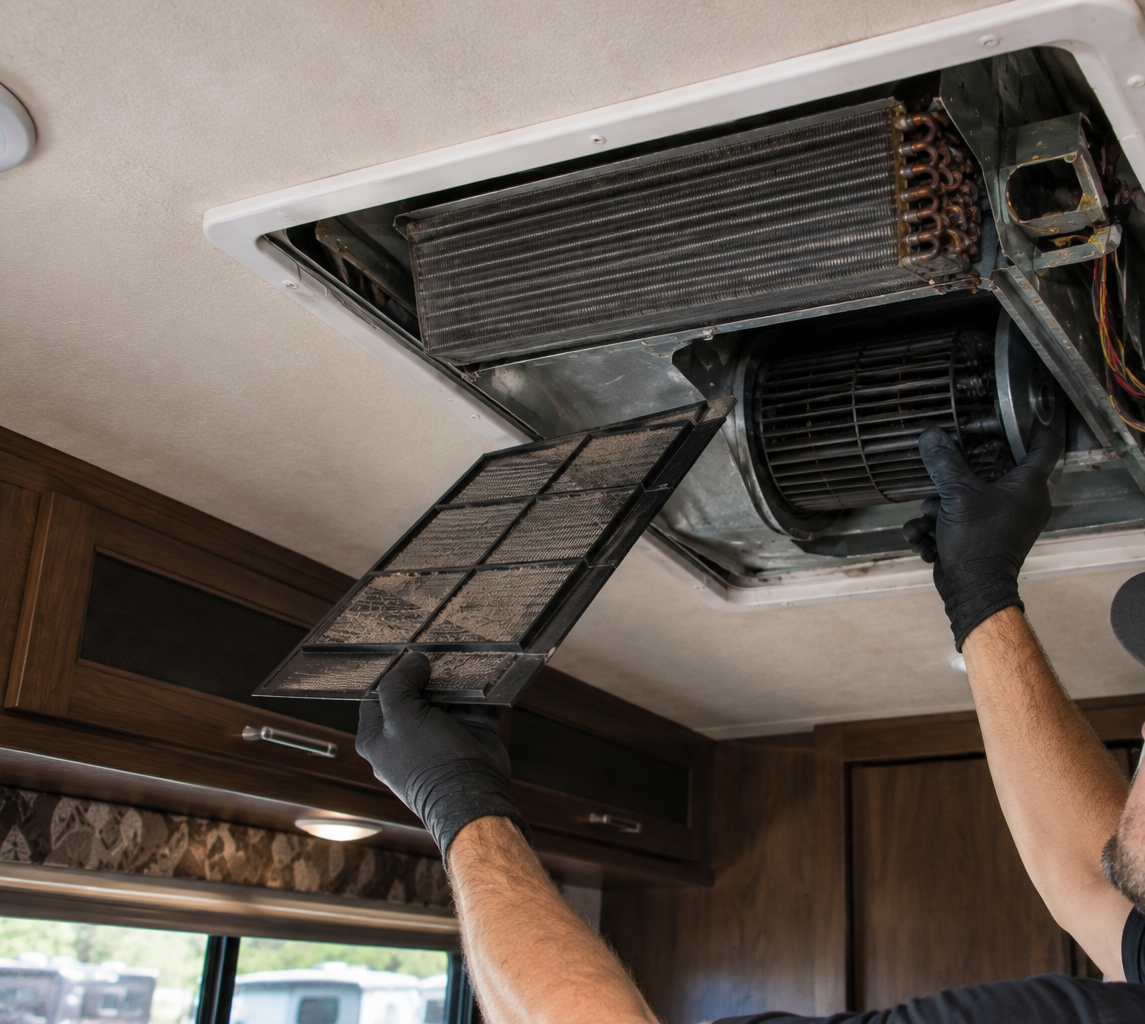
A healthy rooftop unit drops the air 16 to 22 degrees between the return grill and the supply vent, which makes cooling a measurement rather than an argument. Meier RV Repair LLC repairs RV air conditioning in Coldwater and throughout Branch County, MI, testing airflow, capacitors, voltage, and controls before recommending anything at all. Diagnostics start on our contact page.
COLD AIR IS A MEASUREMENT, NOT AN OPINION.
Two owners describe the same complaint completely differently. One says the unit is blowing warm, another says it just cannot keep up. A thermometer at the return and another at the vent settles which of those is actually happening, and the number tells us whether we are chasing airflow, a failed capacitor, or a compressor that has stopped pulling its weight.
That is where every air conditioning job here begins, because guessing on a sealed system gets expensive very quickly, and because the difference between a capacitor and a compressor is the difference between an afternoon and a whole new unit.
✓ Temperature split measured at the vents
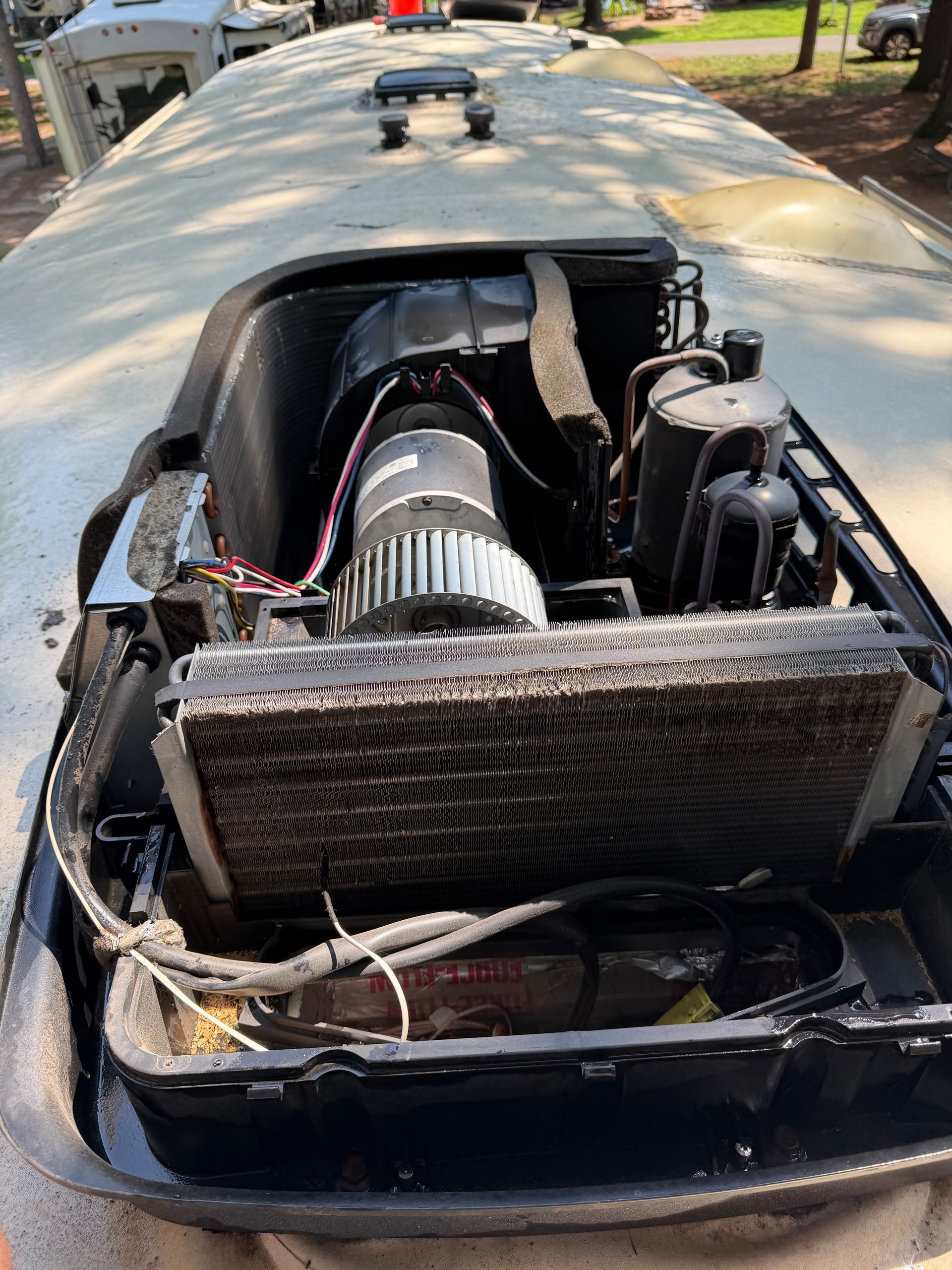
✓ Filters, coils, and airflow checked first
✓ Capacitors and motors tested under load
✓ Straight answer on repair versus replacement
RV AIR CONDITIONING
ROOFTOP UNITS ARE SEALED, WHICH CHANGES EVERYTHING.
Home and automotive air conditioning can be recharged. An RV rooftop unit cannot. It leaves the factory with a fixed refrigerant charge and no service ports, so any shop offering to top yours up is working on something else. That fact reshapes the diagnosis: a unit genuinely low on refrigerant gets replaced, and when it is not, the fault is almost always airflow, a capacitor, a motor, or the voltage feeding it.
JULY IN COLDWATER ASKS A LOT OF ONE COMPRESSOR.
Summer highs here average around 82 degrees, and a trailer parked in full sun runs far hotter than that inside. A 13,500 BTU unit fighting an uninsulated roof, open blinds, and a full campground pedestal at low voltage will run continuously and still disappoint. We look at the whole picture, including supply voltage, because a compressor starved below 105 volts shuts down long before it cools anything.
A THERMOMETER SETTLES MOST ARGUMENTS ABOUT COOLING.
Owners often arrive convinced the unit is finished. Roughly half the time the filter is packed, the condenser coil is matted with cottonwood, or a run capacitor has failed and the compressor is only humming. Those repairs cost a fraction of a replacement. In 10 years of RV work, taking the readings before quoting has saved a lot of people from buying a rooftop unit they did not need.
WHAT A CORRECT AC REPAIR RESTORES
USABLE SUMMER DAYS
An RV that cools properly is one you can actually sit in during the afternoon. That changes a trip from waiting for sunset into using the whole day the way you planned.
SLEEP THAT IS NOT INTERRUPTED
A unit that short cycles all night wakes people repeatedly and still leaves the bedroom warm. Correct airflow and a healthy compressor restore steady, quiet operation instead of constant starting and stopping.
PROTECTION FOR THE COMPRESSOR
Running a starved or overheating unit shortens the life of the most expensive component inside it. Fixing airflow and voltage problems early protects the part you cannot buy separately.
NO WASTED REPLACEMENT SPENDING
Plenty of units condemned as dead needed a capacitor and a clean coil. An accurate diagnosis makes sure your money goes toward the actual fault rather than a whole new assembly.
QUIETER OPERATION
Loose shrouds, dry fan bearings, and unbalanced blower wheels turn a working unit into a noisy one. Addressing them makes the RV noticeably more pleasant without touching the cooling side at all.
PREDICTABLE POWER DRAW
A properly running unit draws the current it should rather than tripping breakers and struggling on startup. That matters at every campground pedestal you plug into afterward.
WHAT WE FIX
OUR RV AIR CONDITIONING WORK
Rooftop cooling problems fall into a handful of categories, and each one has its own test. Here is the air conditioning work we handle at our shop here in Coldwater, MI.
DIAGNOSIS
Cooling Performance Testing
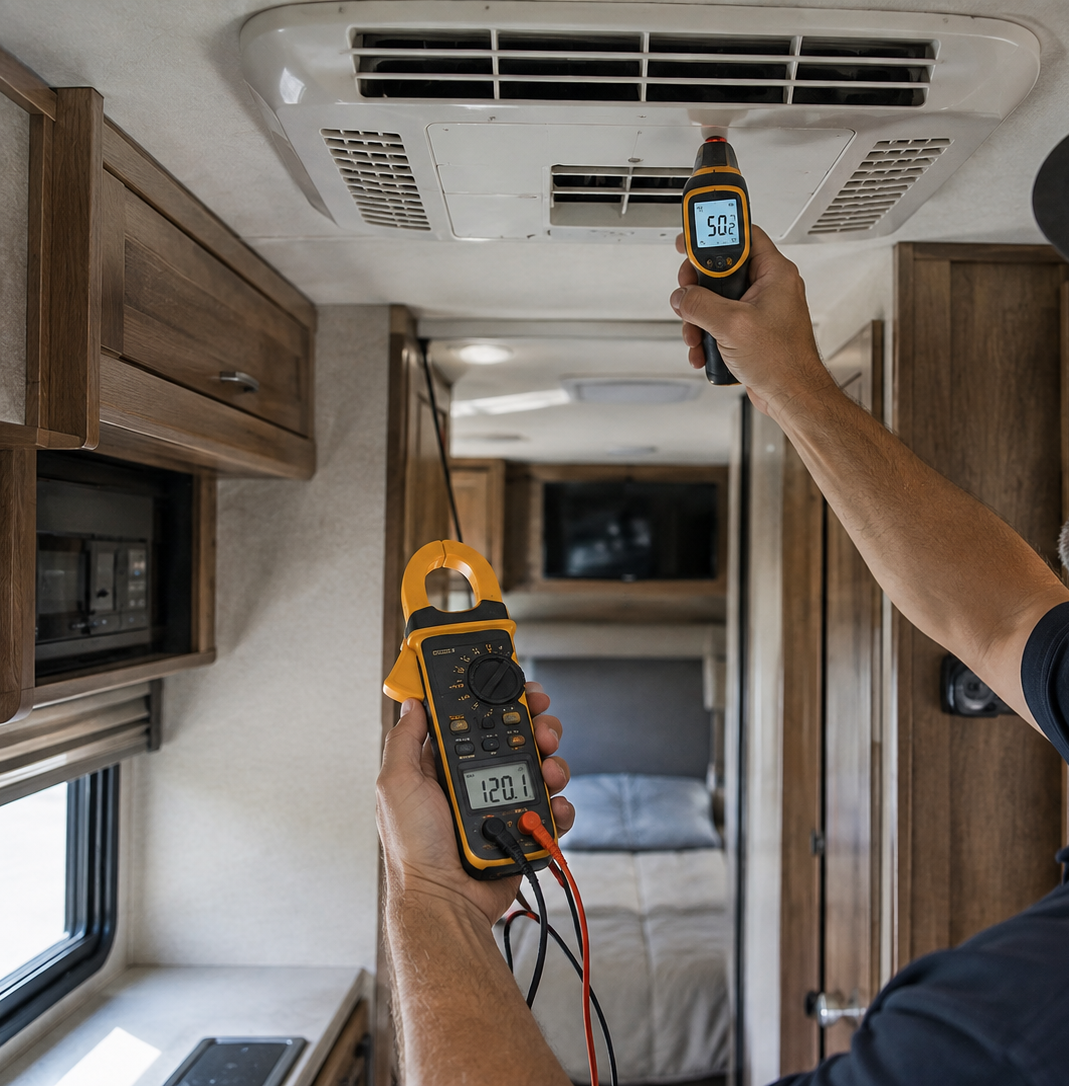
We measure the temperature split across the unit, check airflow through the return, and verify the supply voltage under load. Those three readings separate a real cooling fault from a maintenance problem within minutes.
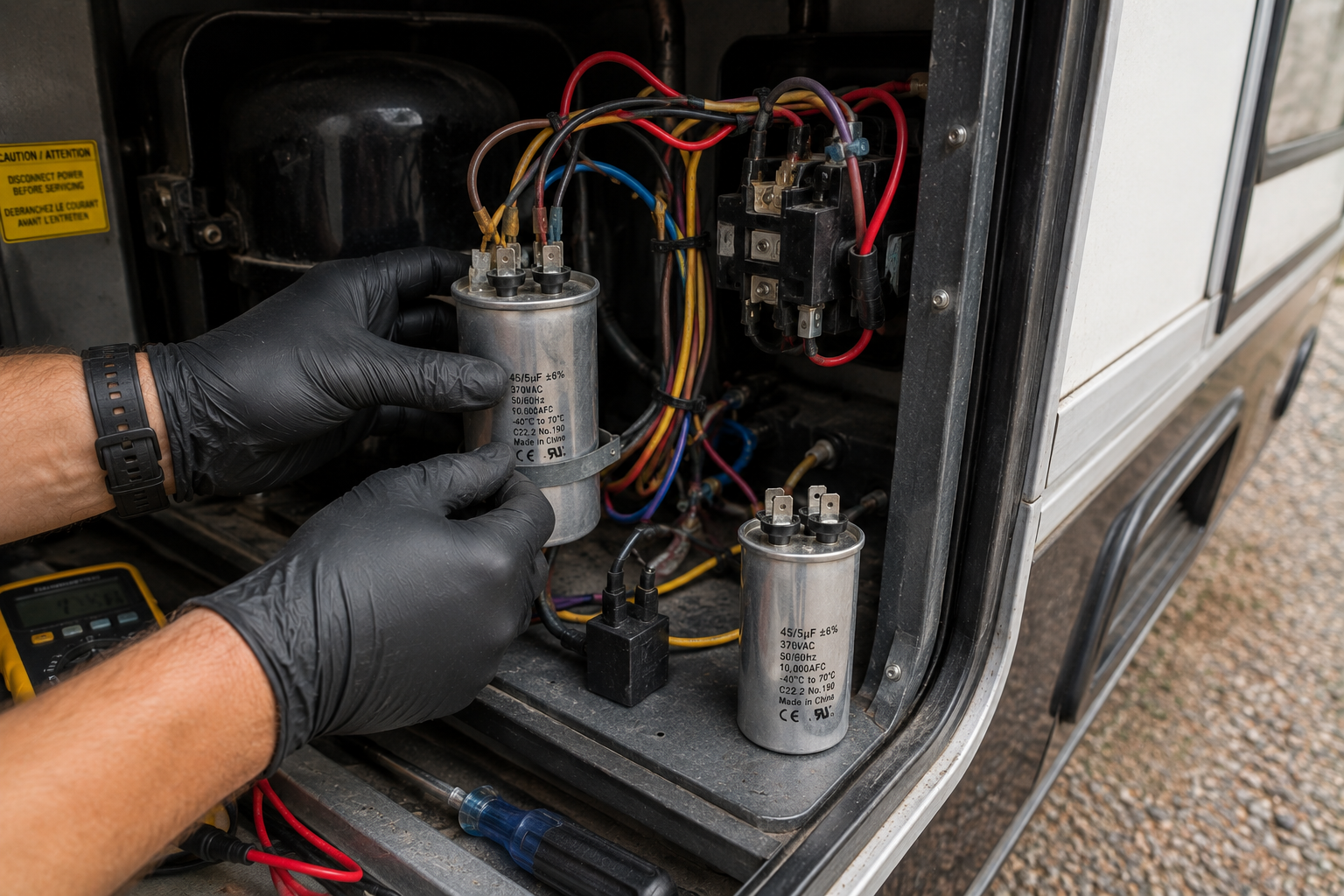
CAPACITORS
Capacitor and Relay Replacement
A compressor that hums, clicks, then trips its overload almost always points to a failed run capacitor. Replacing it costs a fraction of a new unit and restores normal starting immediately.
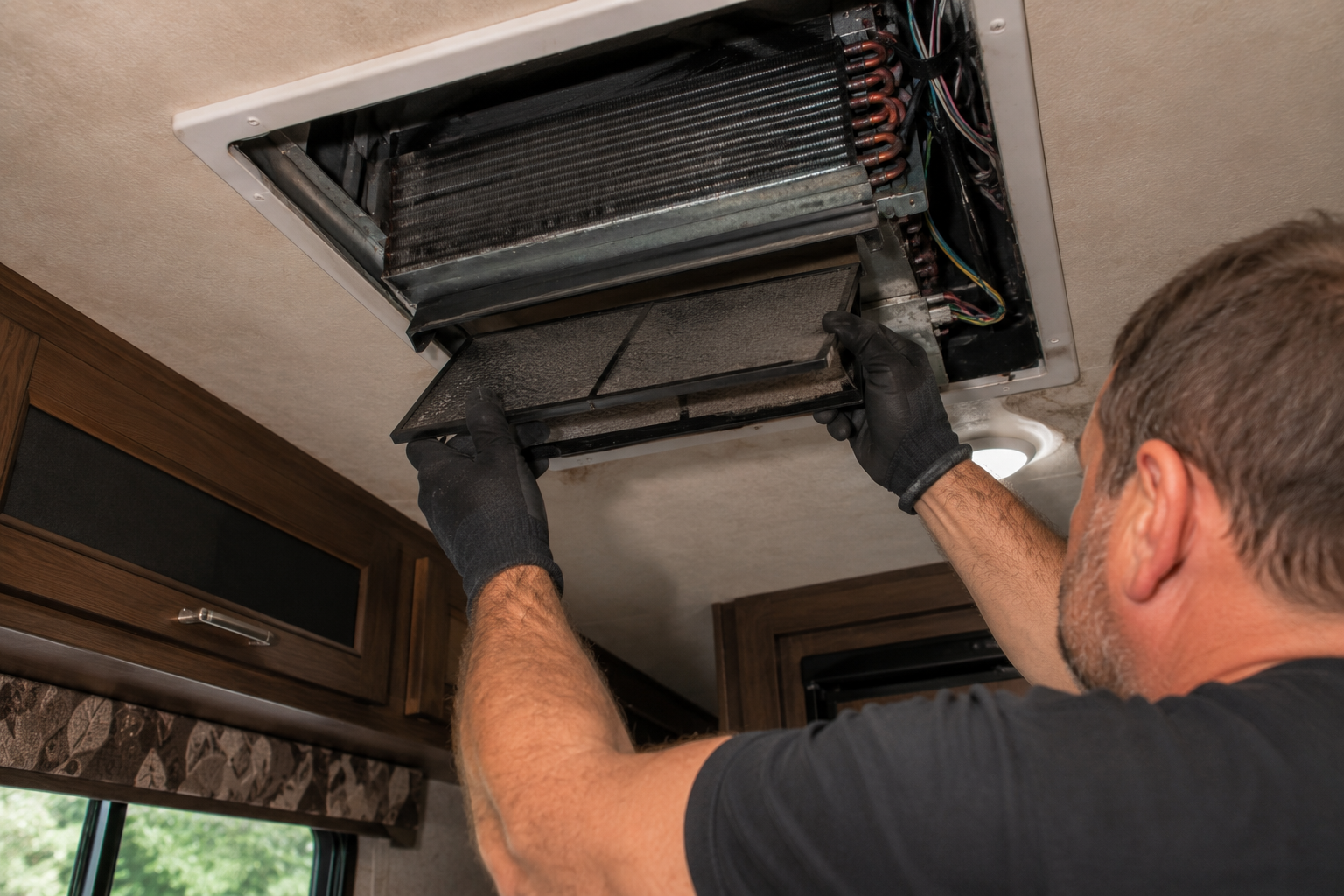
AIRFLOW
Filter, Coil, and Blower Service
A clogged filter can cut evaporator airflow dramatically, which causes both weak cooling and iced coils. We clean filters, comb and wash coils, and check the blower wheel for the debris that unbalances it.
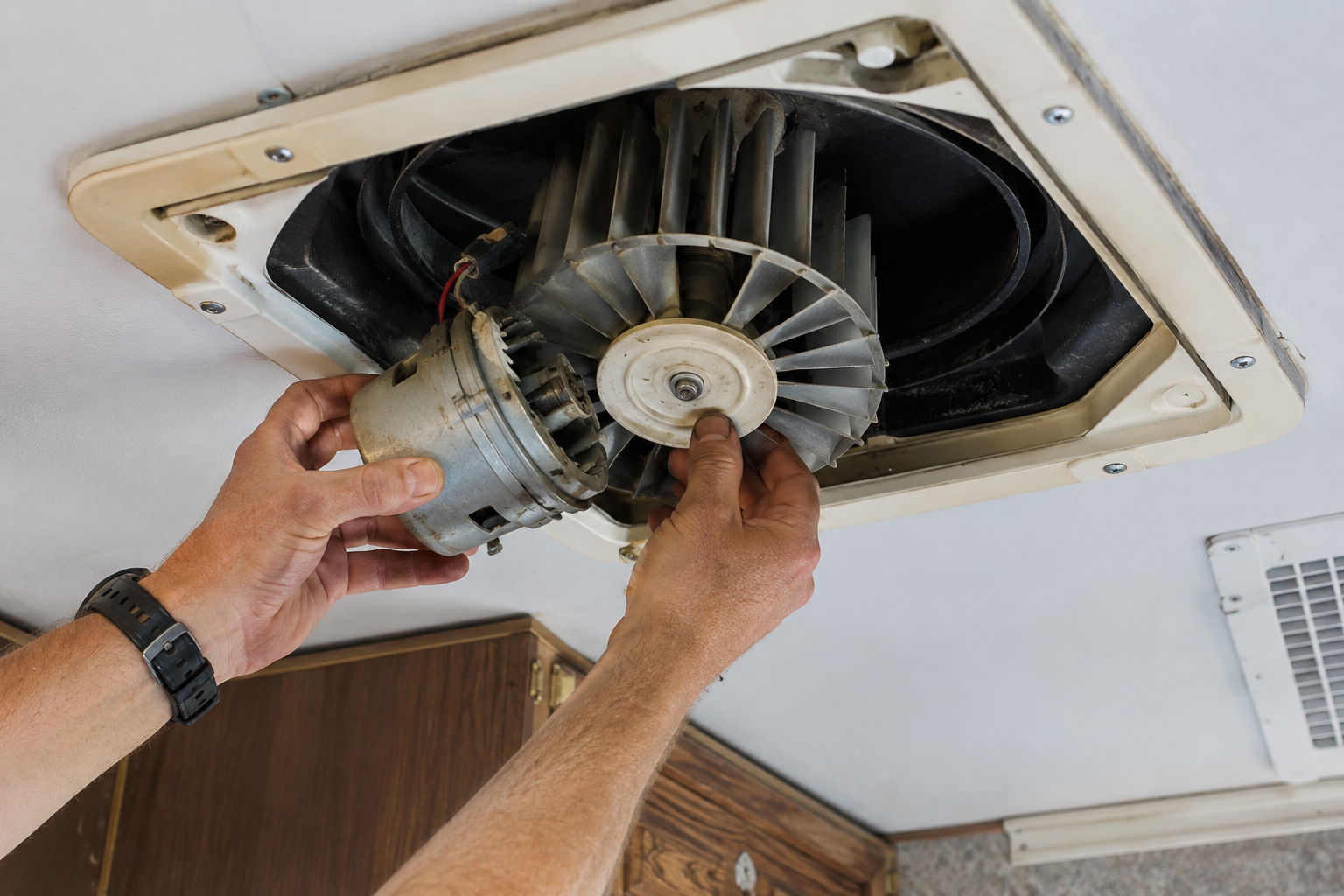
MOTORS
Fan and Blower Motor Repair
Bearings dry out, blades crack, and motors lose speed long before they stop entirely. We test current draw and replace the motors and wheels that no longer move the volume of air the design assumes.
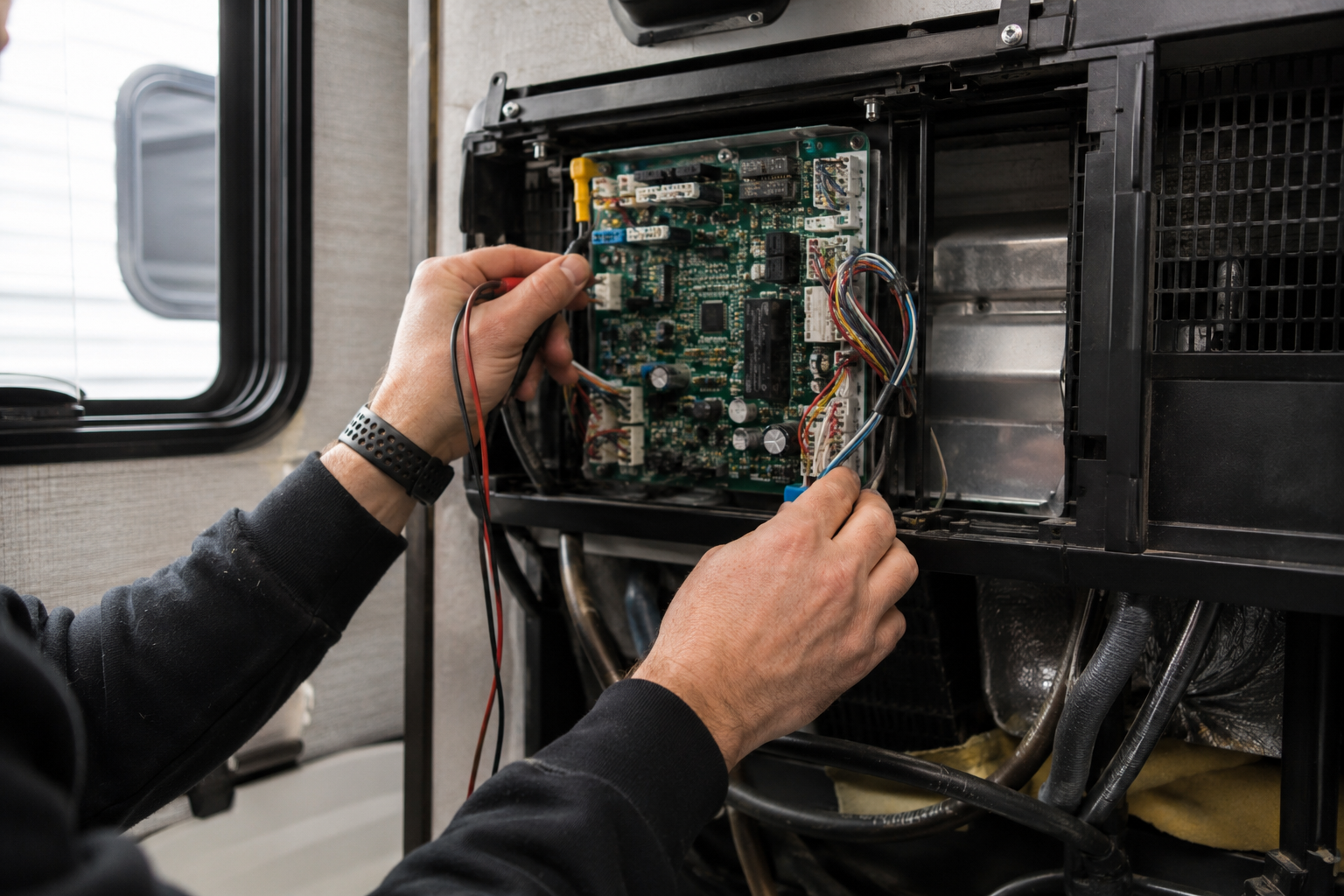
CONTROLS
Thermostat and Control Board Repair
Units that will not start, will not shut off, or ignore the setting often have a control fault rather than a mechanical one. We test thermostats, wiring, and boards before condemning anything on the roof.
REPLACEMENT
Rooftop Unit Replacement
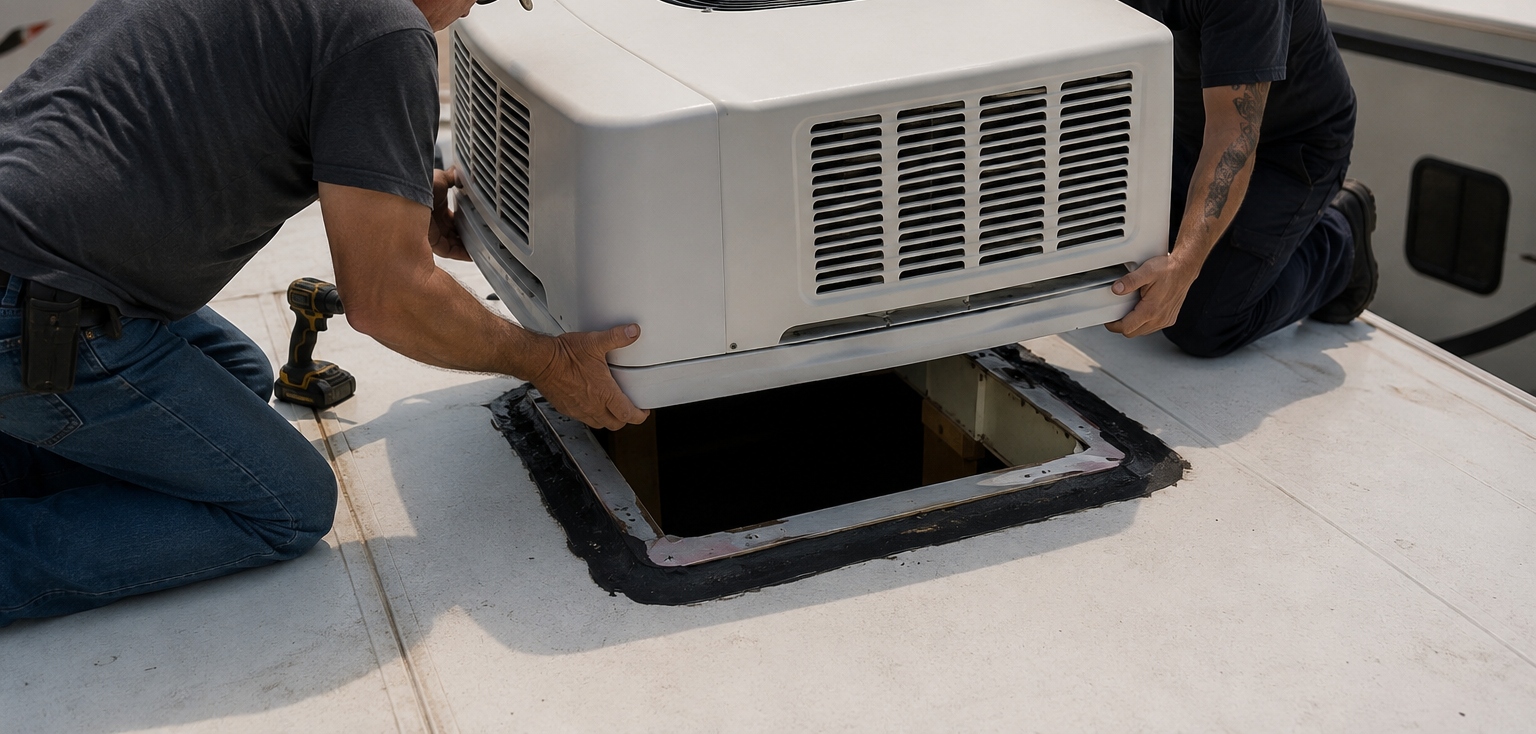
When the sealed system has genuinely failed, the assembly gets replaced rather than opened. We fit the correct BTU rating for your rig, set a new gasket, and seal the opening properly.
Common Questions
FREQUENTLY ASKED QUESTIONS.
Cooling questions arrive in a rush every June around Branch County, so here are the ones we end up answering most often about rooftop air conditioners.
Why is my RV air conditioner running but not cooling?
The usual causes are restricted airflow from a clogged filter or coil, a failed run capacitor, or supply voltage too low to run the compressor. Meier RV Repair LLC measures all three in Coldwater, MI before condemning a unit.
How many degrees should an RV air conditioner drop the air?
Expect a 16- to 22-degree difference between the air entering the return grill and the air leaving the supply vent. Anything much below that range points to an airflow restriction or a compressor that is no longer performing properly.
Can an RV rooftop air conditioner be recharged?
No. These are sealed systems with no service ports at all, built with a fixed factory charge. A unit that has genuinely lost refrigerant gets replaced rather than topped up, and refrigerant handling requires federal certification in any case.
Why is my RV air conditioner freezing up?
Ice on the coil almost always means insufficient airflow across it, from a dirty filter, a matted coil, or a weak blower. Running the unit in cool, humid weather with the fan on low produces the same result.
Why does my RV AC hum but not start?
That signature usually belongs to a failed run capacitor. The compressor tries to start, cannot get moving, draws heavy current, and trips its own thermal overload within seconds. Meanwhile the fan itself often keeps running perfectly normally throughout.
How often should AC filters and coils be cleaned?
Clean the return filter every 2 to 4 weeks during heavy use, and wash the condenser coil once each season. Around Coldwater, MI, cottonwood seed loads a coil faster than owners expect, as Meier RV Repair LLC keeps finding.
What is the difference between ducted and non ducted?
The rooftop unit itself is identical. Ducted systems distribute air through ceiling ducts to multiple vents, while non ducted units discharge through a single ceiling assembly directly below the unit. Only the interior ceiling plenum is different between the two.
Is 13,500 or 15,000 BTU enough for my camper?
That depends on length, insulation, window area, and how much shade you park in. A 15,000 BTU unit recovers faster in extreme heat, but it draws more current and needs an electrical supply that can actually match it.
HOW WE WORK
FROM FIRST READING TO COLD VENTS, HERE IS HOW.
STEP 01
Take the baseline readings
Return and supply temperatures, airflow, and voltage under load all get recorded before anything is opened up. Those numbers define the problem and give us something to compare against when the repair is finished.
STEP 02
Rule out the simple causes
Filters, coils, blower wheels, and shroud fit account for a large share of the poor cooling complaints we see. We address those first, because no component replacement fixes a unit that cannot move air.
STEP 03
Test the electrical side
Capacitors, relays, thermostats, and wiring connections are all checked under actual operating load rather than at rest. Many intermittent faults only ever appear in the moment when the compressor first tries to start.
STEP 04
Give you the honest options
You hear what the readings show, what a repair would involve, and whether replacement makes better sense for your unit. We put the numbers in front of you rather than asking you to take our word.
STEP 05
Repair or replace correctly
Components are replaced with the correct ratings, and full unit swaps get the right BTU output for the rig itself. Roof gaskets are renewed and the opening resealed whenever a unit comes off.
STEP 06
Retest before it leaves
The same readings are taken again once the repair is complete, so the improvement is measured rather than assumed. You get those before and after numbers handed over to you along with your paperwork.
GET YOUR REPAIR ESTIMATE
BOOK THE AC WORK BEFORE THE FIRST HOT WEEK.
Tell us the make, the BTU rating, and exactly what the unit is doing through our contact page. We will explain what testing involves and get you scheduled before the campgrounds fill and the temperature climbs.
WHAT YOUR AC DIAGNOSIS COVERS:
✓ Measured temperature split at the vents
✓ Airflow and filter condition checked
✓ Condenser and evaporator coils inspected
✓ Capacitors and motors tested under load
✓ Supply voltage verified at the pedestal
✓ Repair or replace explained with the numbers