RV Electrical Plumbing
RV ELECTRICAL AND PLUMBING IN Branch County, MI
A 30-amp hookup delivers 3,600 watts on a single leg while a 50-amp pedestal supplies 12,000 watts across two, which explains most of the tripped breakers at a campsite. Meier RV Repair LLC repairs RV electrical and plumbing in Coldwater and across Branch County, MI, tracing converters, batteries, shore power, pumps, and fresh water lines. Begin on our contact page.
12 VOLTS AND 120 VOLTS SHARE ONE RIG.
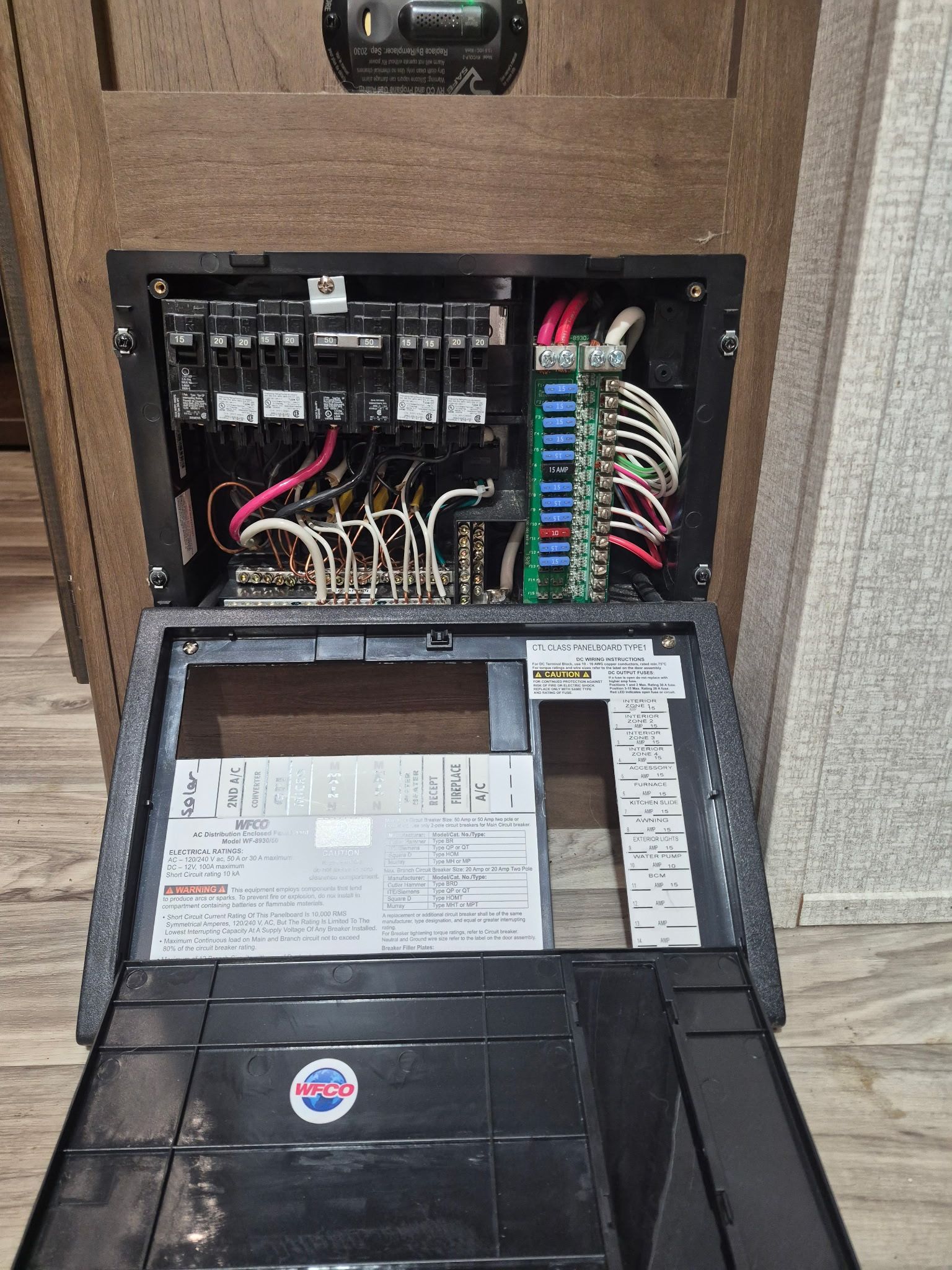
That is what makes RV electrical work different from house wiring. Your lights, pumps, furnace board, and slide motors run on 12-volt direct current from the batteries, while outlets, air conditioning, and the microwave run on 120-volt alternating current from shore power. The converter feeds one from the other, and when it fails, the symptoms appear on both sides at once.
Plumbing sits right alongside all of it, sharing the same cabinets, the same wall cavities, and the same underbelly. So we trace faults across both systems rather than treating them as separate jobs.
✓ Batteries, converter, and shore power tested
✓ Faults traced to the circuit, not guessed
✓ Fresh, hot, and waste lines pressure checked
✓ Winterizing done properly, not partially
RV ELECTRICAL AND PLUMBING
POWER PROBLEMS HIDE BEHIND OTHER PROBLEMS.
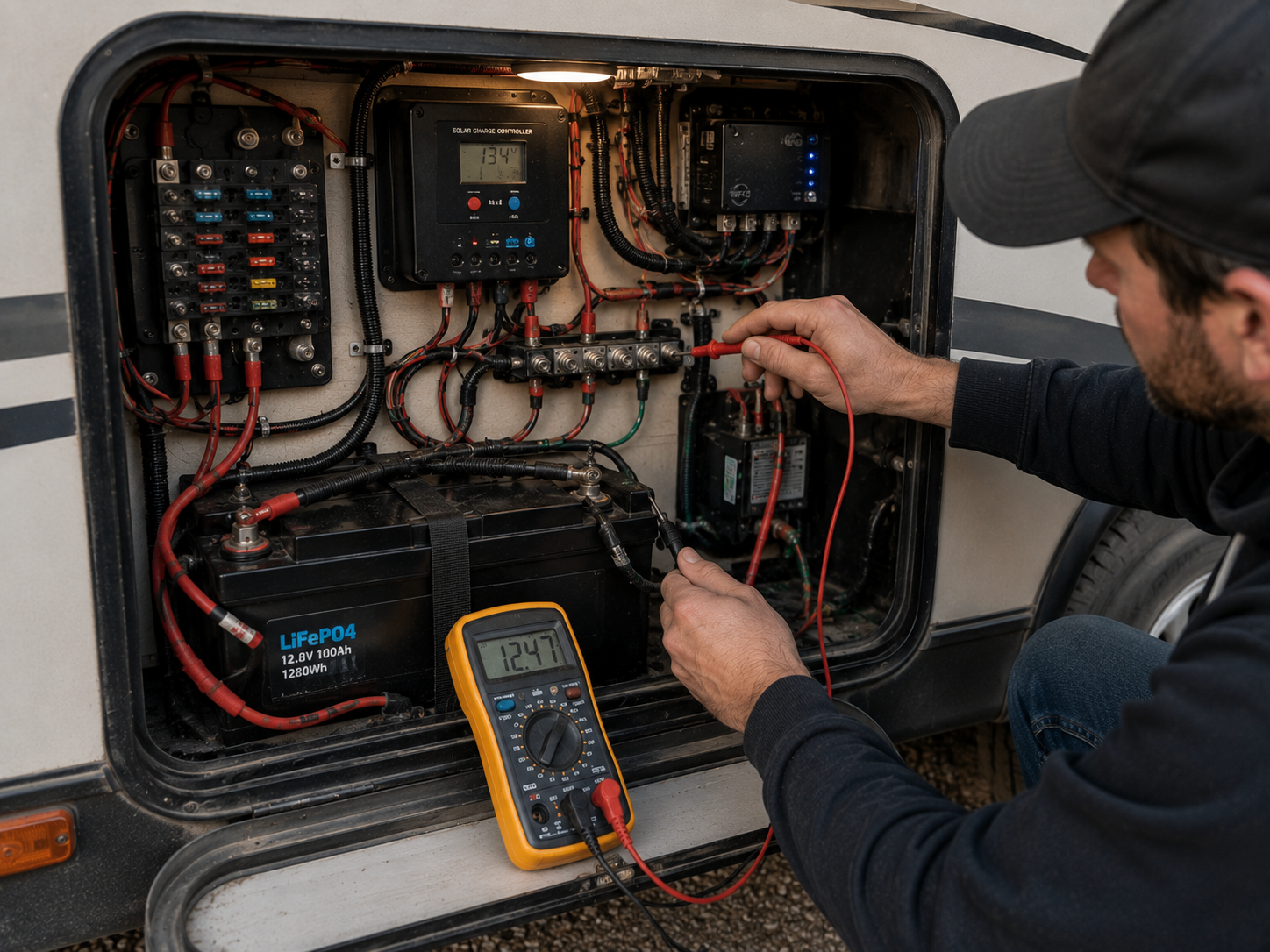
An owner arrives complaining that the furnace will not run, the lights dim at night, and the water pump sounds weak. Three complaints, one cause: a converter that stopped charging weeks ago and batteries that have been slowly draining ever since. That pattern repeats constantly. Rather than replacing a furnace board and a pump, we measure voltage at rest and under load first, because a 12-volt system running at 11 makes everything on board look faulty.
FREEZING NIGHTS SPLIT FITTINGS, NOT PIPES.
PEX tubing expands as water freezes and usually survives it. The brass and plastic fittings crimped onto it do not, which is why spring leaks show up at elbows, tees, and pump connections rather than mid run. With January lows around 18 degrees in Branch County and a cold season stretching from December into March, a heater left undrained or a line left holding water is a repair waiting for the thaw.
THE METER DECIDES, NOT THE PARTS CATALOG.
Parts cannons are expensive. A meter, a pressure gauge, and a methodical order find the actual failure faster than swapping components and hoping, and after 10 years of RV work we have very little patience for the alternative. Whether the complaint is a dim light, a nuisance tripping outlet, or water dripping through the underbelly, the process is the same: isolate, measure, confirm, then repair.
WHAT A CLEAN SYSTEM REPAIR DELIVERS
POWER YOU CAN TRUST
Lights that stay bright, a furnace that starts, and outlets that hold under load make a rig feel dependable again. Electrical faults undermine confidence in everything else on board.
NO SLOW BATTERY DAMAGE
A converter that has quit charging kills an expensive battery bank quietly over a season. Catching it early protects hardware that costs far more than the repair itself does.
DRY CABINETS AND FLOORS
Small plumbing leaks soak subfloor and cabinetry long before anyone notices a puddle. Finding and fixing them early keeps a plumbing repair from turning into a floor repair.
SAFE CAMPGROUND HOOKUPS
Faulty grounds, reversed polarity, and overloaded circuits are genuine hazards, not just inconveniences. Correct wiring and protection mean plugging in anywhere without wondering what the pedestal will do.
WATER PRESSURE THAT HOLDS
A pump that cycles constantly or a system that will not hold pressure signals a leak somewhere. Restoring proper pressure makes showers, sinks, and toilets behave the way they should.
WINTERS WITHOUT DAMAGE
Correct winterizing protects lines, fittings, pumps, and valves through months of freezing weather. It is a small piece of seasonal work that prevents one of the most common spring repairs.
WHAT WE TRACE
OUR RV ELECTRICAL AND PLUMBING WORK
Electrical and plumbing faults live in the same cabinets, run through the same underbelly, and regularly cause each other. Here is the work we handle across both of those systems.
12 VOLT
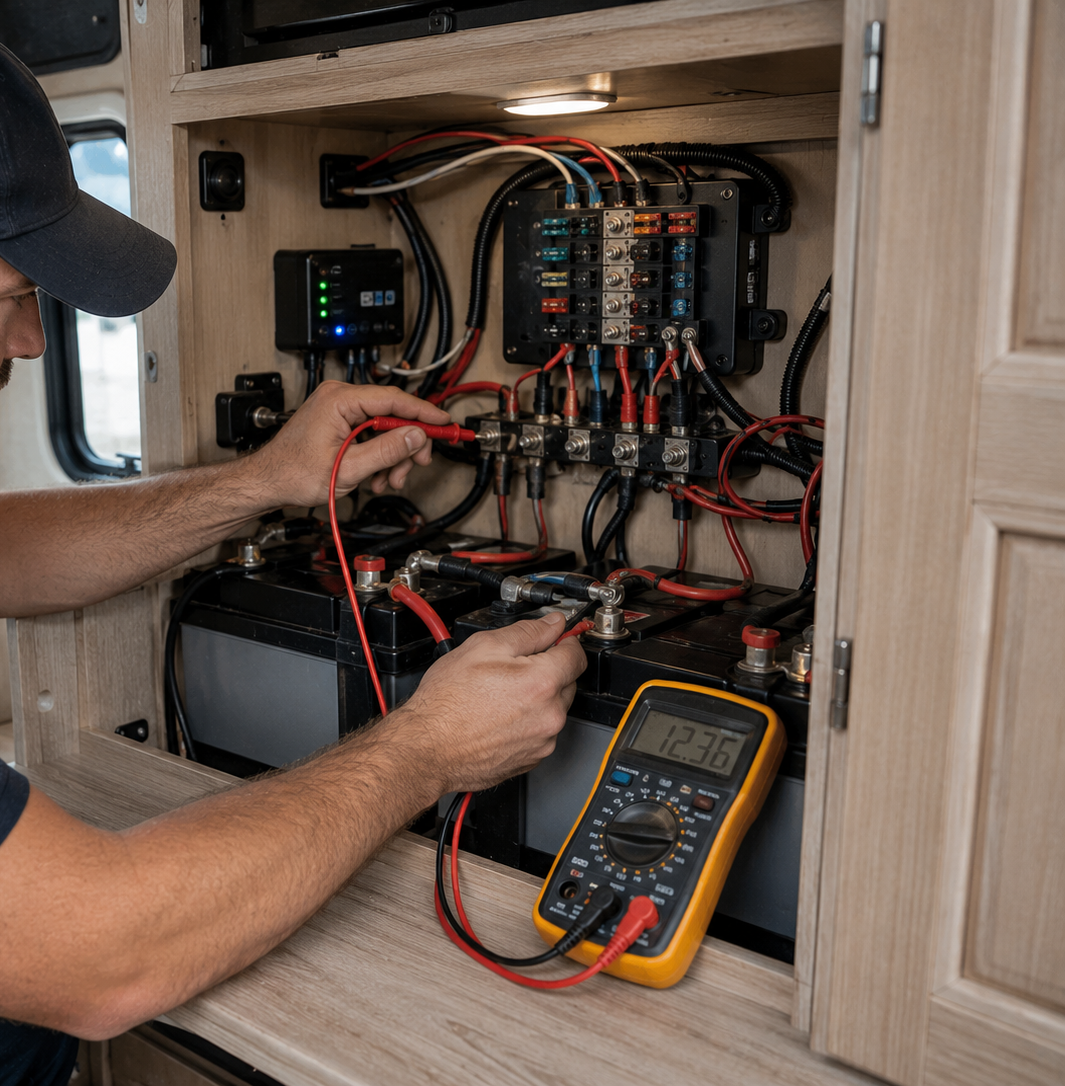
12 Volt System Diagnosis
Dim lights, dead outlets, and appliances that behave strangely usually trace to voltage drop, corroded grounds, or a failing battery bank. We test under load and follow the circuit to where the loss actually occurs.
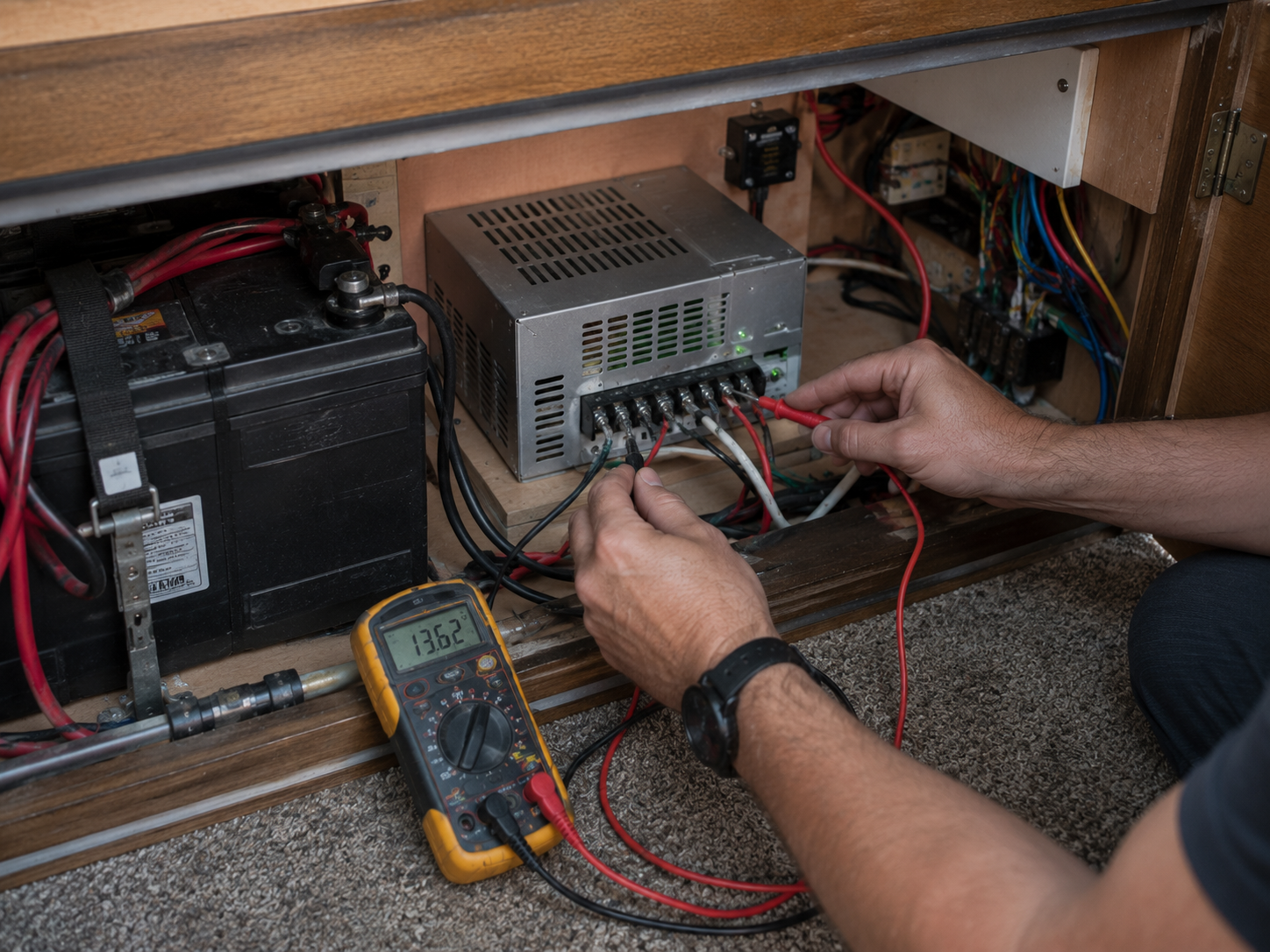
CONVERTER
Converter, Inverter, and Charging Repair
A converter that stops charging drains the batteries and starves every 12-volt device on board. We test charging output through its stages, check connections, and replace units that no longer hold their voltage.
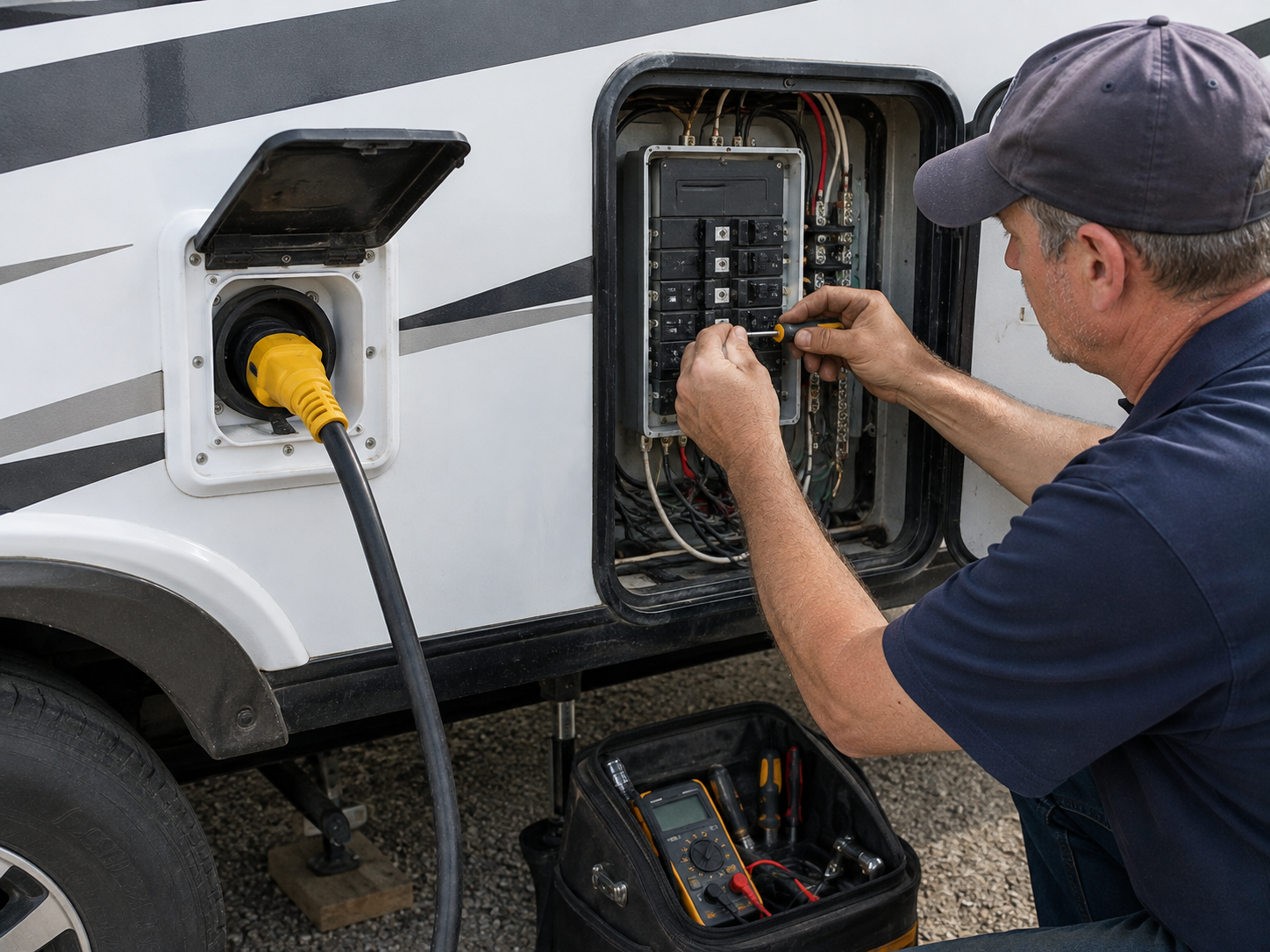
SHORE POWER
Shore Power and Breaker Repair
Cords, inlets, transfer switches, and distribution panels all take abuse at the pedestal. We repair damaged inlets, correct wiring faults, and diagnose the breakers and outlets that trip when the load comes on.
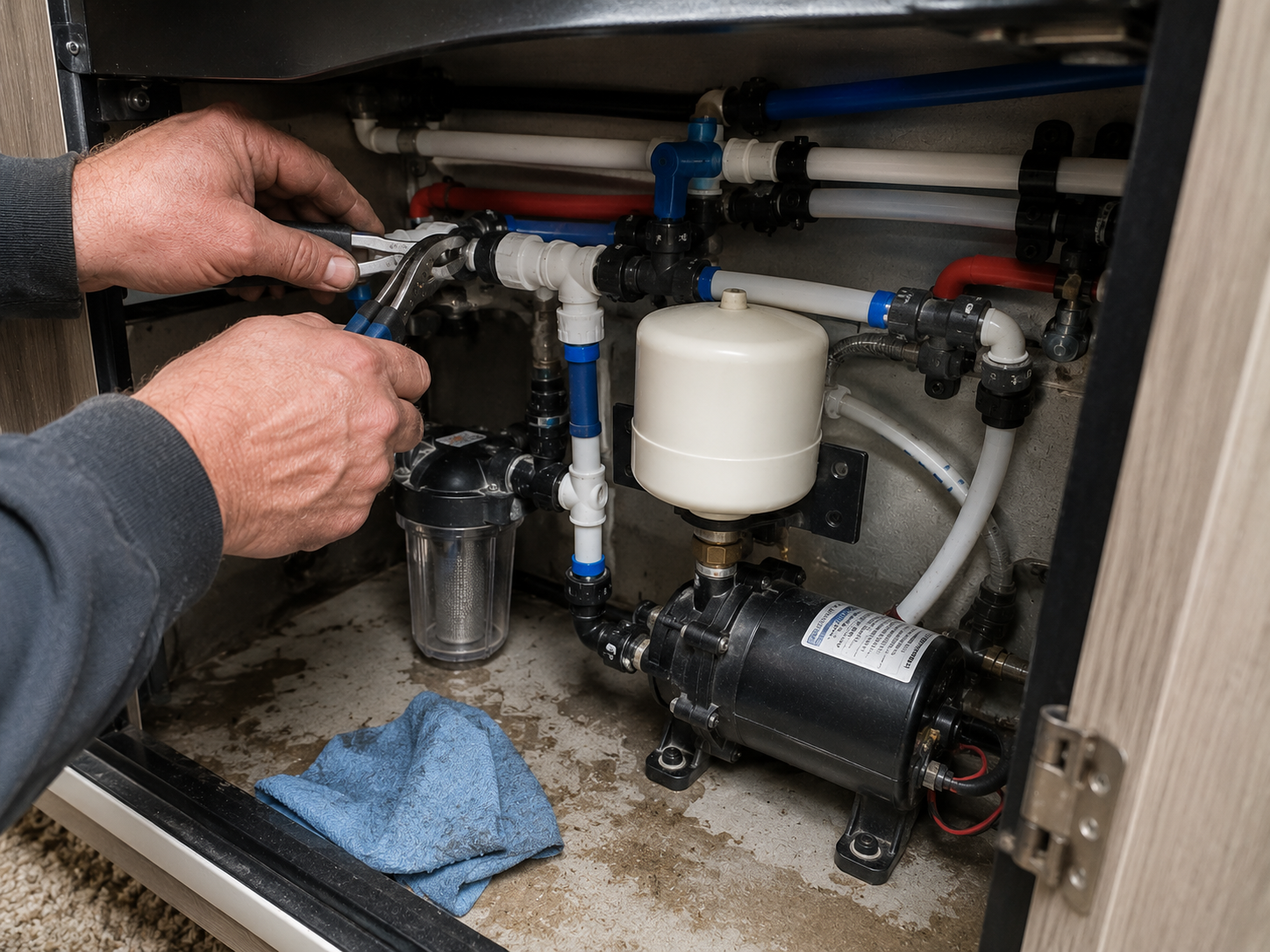
FRESH WATER
Fresh Water Line and Pump Repair
Leaking fittings, cracked PEX, weak pumps, and low pressure at the tap are traced to their source rather than patched at the symptom. Accumulators and regulators are fitted where they solve the problem.
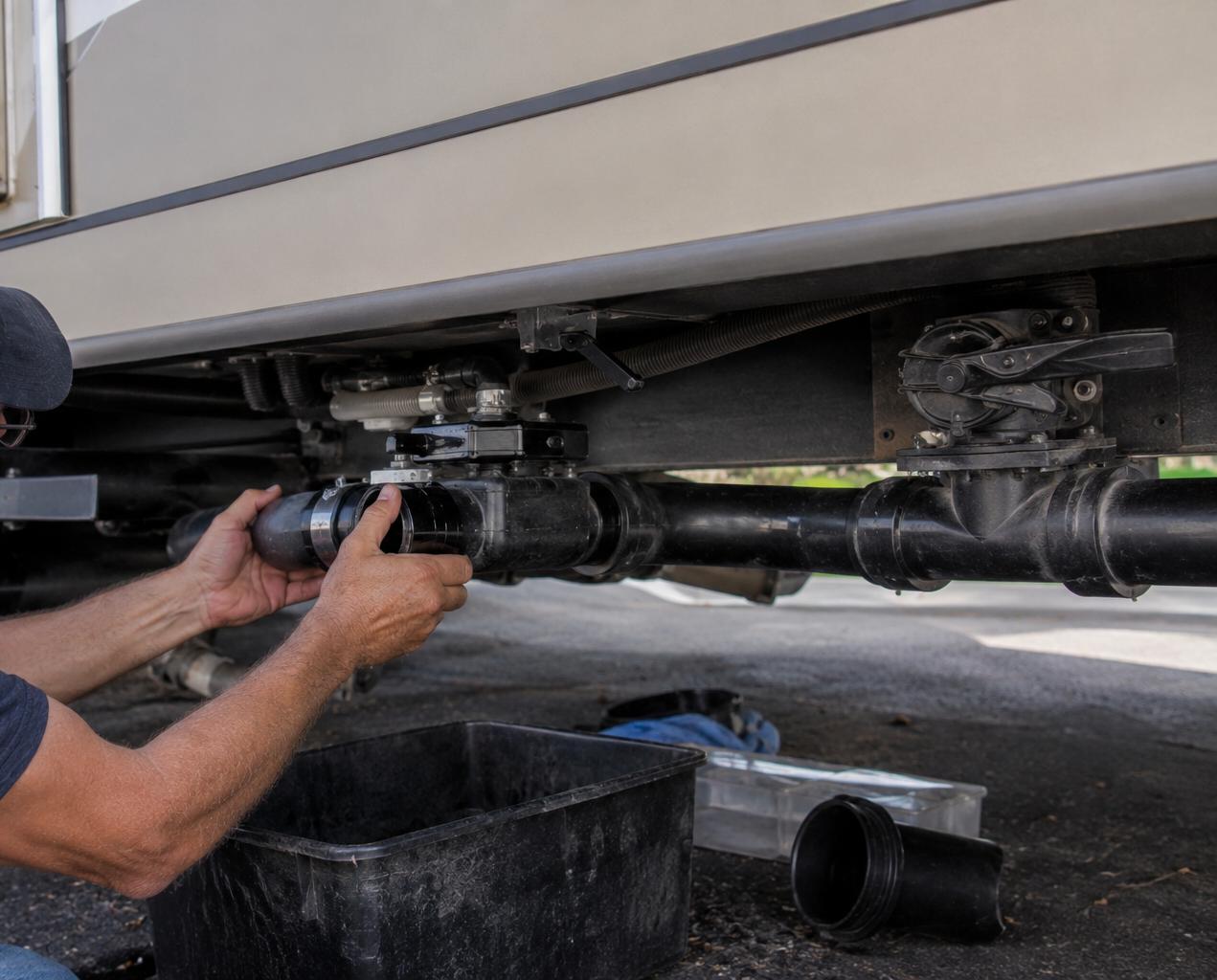
WASTE SYSTEM
Waste Plumbing and Tank Repair
Slow drains, sewer odors inside, stuck valves, and failed tank sensors each have their own cause. We repair drain lines, replace gate valves and seals, and correct the venting that makes a rig smell.
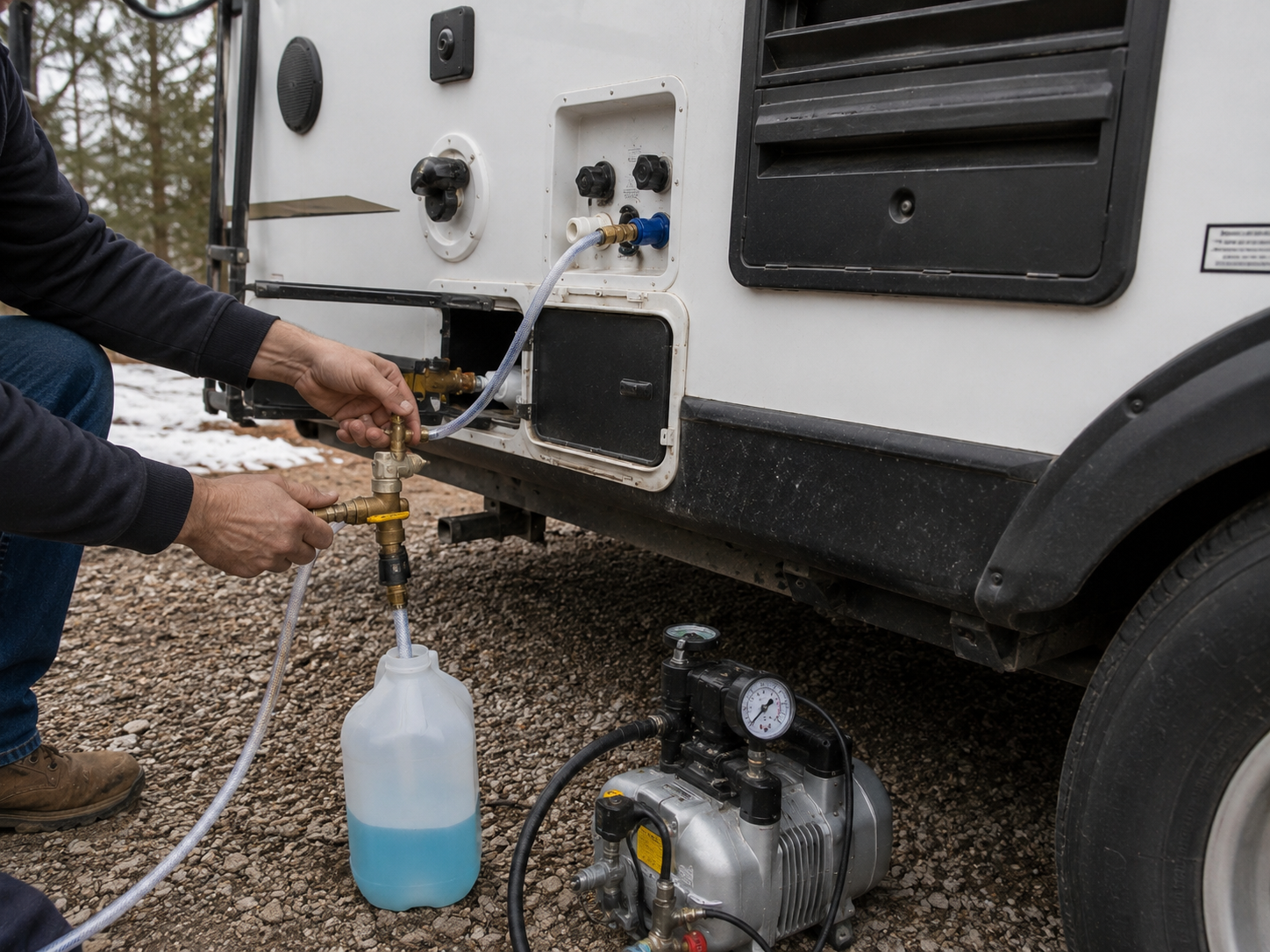
WINTERIZING
Winterizing and Spring Startup
Draining, bypassing the water heater, and filling the lines properly is the difference between a working system and a spring full of split fittings. Startup service reverses it and pressure tests the whole system.
Common Questions
FREQUENTLY ASKED QUESTIONS.
These questions come up whenever something electrical or plumbing related starts misbehaving, and most of them have a straightforward answer that is worth knowing before you start.
Why are my 12-volt lights dim or flickering?
Dim lighting almost always means low system voltage, from discharged or failing batteries, a converter that has stopped charging, or a corroded ground connection. Testing the voltage at rest and again under load quickly separates those three causes.
Why is my converter not charging the batteries?
Common causes are a blown fuse on the output side, a tripped breaker feeding it, a failed internal component, or corroded connections at the battery. A healthy unit should hold a measurable charging voltage across each of its stages.
What is the difference between 30-amp and 50-amp service?
A 30-amp connection provides 3,600 watts through a single 120-volt leg, while 50-amp service provides a full 12,000 watts across two separate legs. That difference decides whether two rooftop air conditioners can ever run at the same time.
Can I plug a 50-amp RV into a 30-amp pedestal?
Yes, with the correct adapter, but the total available power still stays at just 3,600 watts no matter what your own panel says. Managing what runs at any one time matters far more than the adapter itself does.
Why does my GFCI outlet keep tripping?
Moisture inside an outlet, a failing appliance, or normal leakage current adding up across several devices will all trip a sensitive GFCI receptacle. Isolating the circuits one at a time identifies which device is actually responsible for it.
Why does my water pump keep cycling when no faucet is open?
Cycling with everything closed means the system cannot hold pressure, so water is escaping somewhere or the check valve is leaking back. Meier RV Repair LLC pressure tests the whole system in Coldwater, MI to find exactly where.
Do I need a water pressure regulator?
Yes, you do. Campground supply pressure varies widely and can easily exceed what RV plumbing will tolerate, so a regulator holding it down to roughly 40 to 50 psi will protect every fitting, hose, and fixture in the rig.
Should I blow out the water lines or use RV antifreeze?
Both work when done thoroughly, and many owners combine them. Blowing out needs low pressure and attention to traps, while antifreeze covers the low spots air misses, as spring repairs at Meier RV Repair LLC in Coldwater, MI keep showing.
HOW WE WORK
FROM COMPLAINT TO CLEAN CIRCUIT, HERE IS HOW.
STEP 01
Take the full symptom list
Electrical faults rarely arrive on their own, so we ask about every oddity, including the ones you assumed were completely unrelated. Three small complaints frequently point back at one single failed component somewhere upstream.
STEP 02
Measure the power sources
Battery voltage, converter output, and shore power at the inlet are all measured at rest and under load. Those numbers tell us whether the problem lies in supply, in distribution, or in the device itself.
STEP 03
Isolate the circuit
Breakers, fuses, and grounds all get checked in order until the fault sits on one identified circuit. Isolating properly is what separates a real repair from simply swapping parts until something finally changes.
STEP 04
Pressure test the plumbing
Fresh and waste systems are pressurized and inspected at every accessible fitting, including those behind panels and up in the underbelly. Leaks that only appear under pressure stay hidden from a visual inspection.
STEP 05
Repair to code and specification
Wiring is repaired with the correct gauge and protection, and plumbing with fittings suited to the tubing already in the rig. Temporary fixes are not what we send back out of the shop.
STEP 06
Retest the whole system
Everything gets run together again, because a repaired circuit can still expose a second weak point under full load. We verify that first, then explain what we found and what to watch for.
GET YOUR REPAIR ESTIMATE
LET US TRACE IT INSTEAD OF REPLACING PARTS.
Describe every symptom through our contact page, including the ones that seem unconnected. We will tell you what testing involves, what we suspect from the pattern, and when we can get the rig into the shop.
WHAT YOUR DIAGNOSIS COVERS:
✓ Battery and converter output measured
✓ Shore power and transfer switch tested
✓ Grounds and connections inspected
✓ Fresh and waste plumbing pressure tested
✓ Faults isolated to a specific circuit
✓ Repairs made with correct materials