RV Water Heaters
RV WATER HEATERS IN Branch County, MI
Suburban water heaters use a steel tank protected by a sacrificial anode rod that should be replaced once about 75 percent of it has dissolved, while Atwood aluminum tanks use none. Meier RV Repair LLC services RV water heaters in Coldwater and across Branch County, MI, covering burners, elements, thermostats, valves, anodes, and tankless units. Start on our contact page.
HOT WATER IS A SYSTEM, NOT A BOX.
The warnings are just quiet ones. A freezer that stays cold while the food compartment drifts warm. A faint ammonia smell when you open the outside vent door. Yellow powder or rust streaks on the back of the unit. Each of those has a specific meaning, and together they usually separate a repairable control fault from a cooling unit that has reached the end.
Knowing which one of those you have before spending money is the entire point of a proper diagnosis, and it is why we test each mode and each component in sequence rather than guessing at the answer.
✓ Gas and electric modes tested separately
✓ Cooling unit inspected for leak evidence
✓ Thermistor, board, and burner checked
✓ Straight answer on repair or replacement
RV WATER HEATERS
6 GALLONS DO NOT MAKE A LONG SHOWER.
Most rigs carry a 6- or 10-gallon tank running on a 12,000 BTU burner, with a 1,440-watt element on the electric side. Gas recovers quickly, electric alone recovers slowly, and running both together is the fastest option on units that allow it. Understanding those numbers reframes the complaint: many owners arrive convinced something is broken when the tank is actually performing exactly as designed and simply needs to be used differently.
COLD GROUND WATER MAKES RECOVERY TIME MATTER.
Fill a tank in Branch County during April or October and the incoming water is far colder than what the manufacturer used for its recovery figures. The same heater that felt generous in July feels stingy in autumn, and a tired element or a partly blocked burner turns that into no usable hot water at all. Seasonal service before the cold months keeps recovery where it belongs.
MOST HOT WATER COMPLAINTS HAVE THREE SUSPECTS.
Gas supply, electrical supply, and the valves in between. Working through those in order finds the fault far faster than pulling the unit out, and it usually costs a fraction as much. That habit comes from 10 years of RV work and a lot of water heaters that only needed a bypass valve turned, a thermostat replaced, or a burner tube cleared of a spider nest.
WHAT A SERVICED WATER HEATER GIVES BACK
DEPENDABLE HOT SHOWERS
The point of the appliance is a shower that stays warm from start to finish. Correct burner operation and a clean tank deliver that consistently instead of turning cold three minutes in.
A TANK THAT LASTS LONGER
An anode rod costs very little and exists specifically to corrode instead of your steel tank. Replacing it on schedule is the cheapest way to add years to the appliance.
NO ROTTEN EGG SMELL
Sulfur odor in hot water comes from a reaction inside the tank, not from your water supply. Flushing and changing to the right anode material removes it rather than masking it.
FEWER WINTER REPAIRS
A heater drained and bypassed properly before freezing weather does not split a tank or crack a valve. That single piece of preparation prevents one of the more expensive springtime discoveries.
FASTER RECOVERY
Sediment insulates the bottom of a tank and steals heat that should reach the water. Clearing it restores the recovery rate the unit was designed around, which matters most in cold weather.
QUIET, RELIABLE STARTUP
A clean burner and a healthy igniter light on the first attempt rather than clicking repeatedly. Reliable starting also means fewer lockouts and less time spent resetting things in the dark.
WHAT WE REPAIR
OUR RV WATER HEATER WORK
Water heater service divides between the gas side, the electric side, the tank itself, and the plumbing around it. Here is the work we take on for owners across Branch County.
GAS SIDE
Burner and Ignition Repair
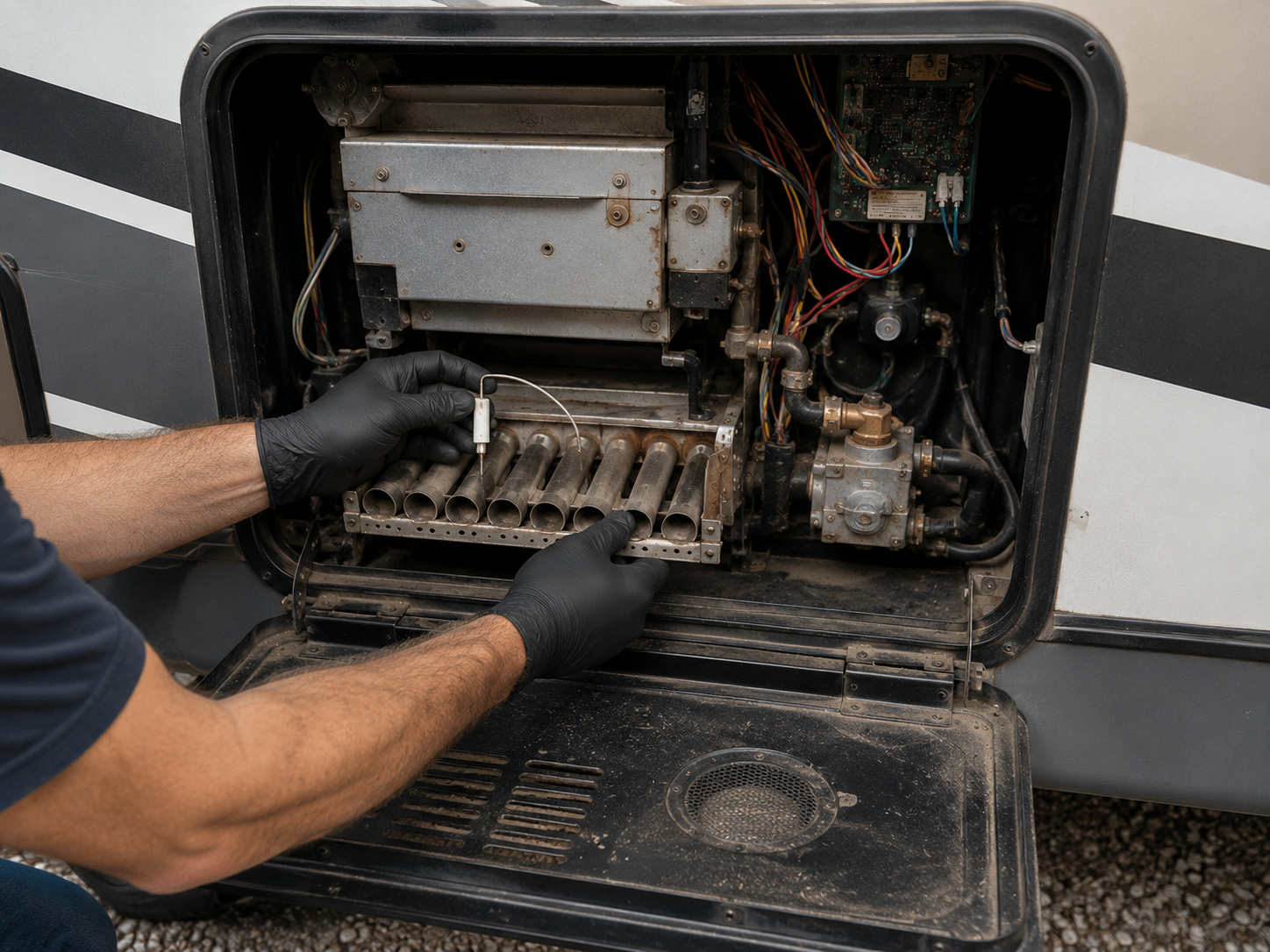
Clicking without lighting, lighting then dropping out, or a flame that will not stay steady usually means a dirty burner tube, a weak electrode, or a failing gas valve. We clean, test, and replace accordingly.
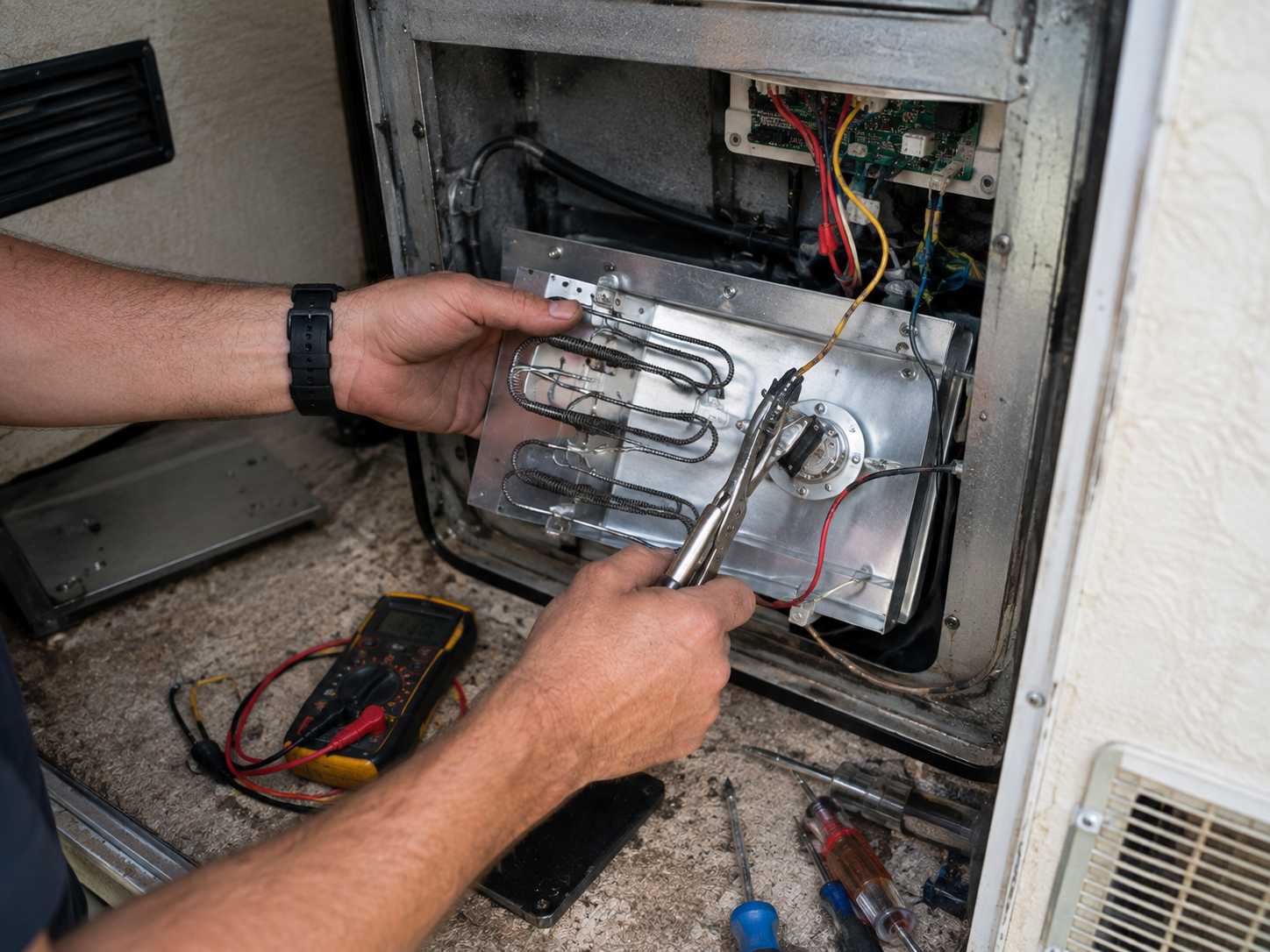
ELECTRIC SIDE
Element and Thermostat Replacement
A heater that works on propane but not electricity has failed on the element, the thermostat, the high limit, or the supply circuit. Resistance testing identifies which one without guessing at parts.
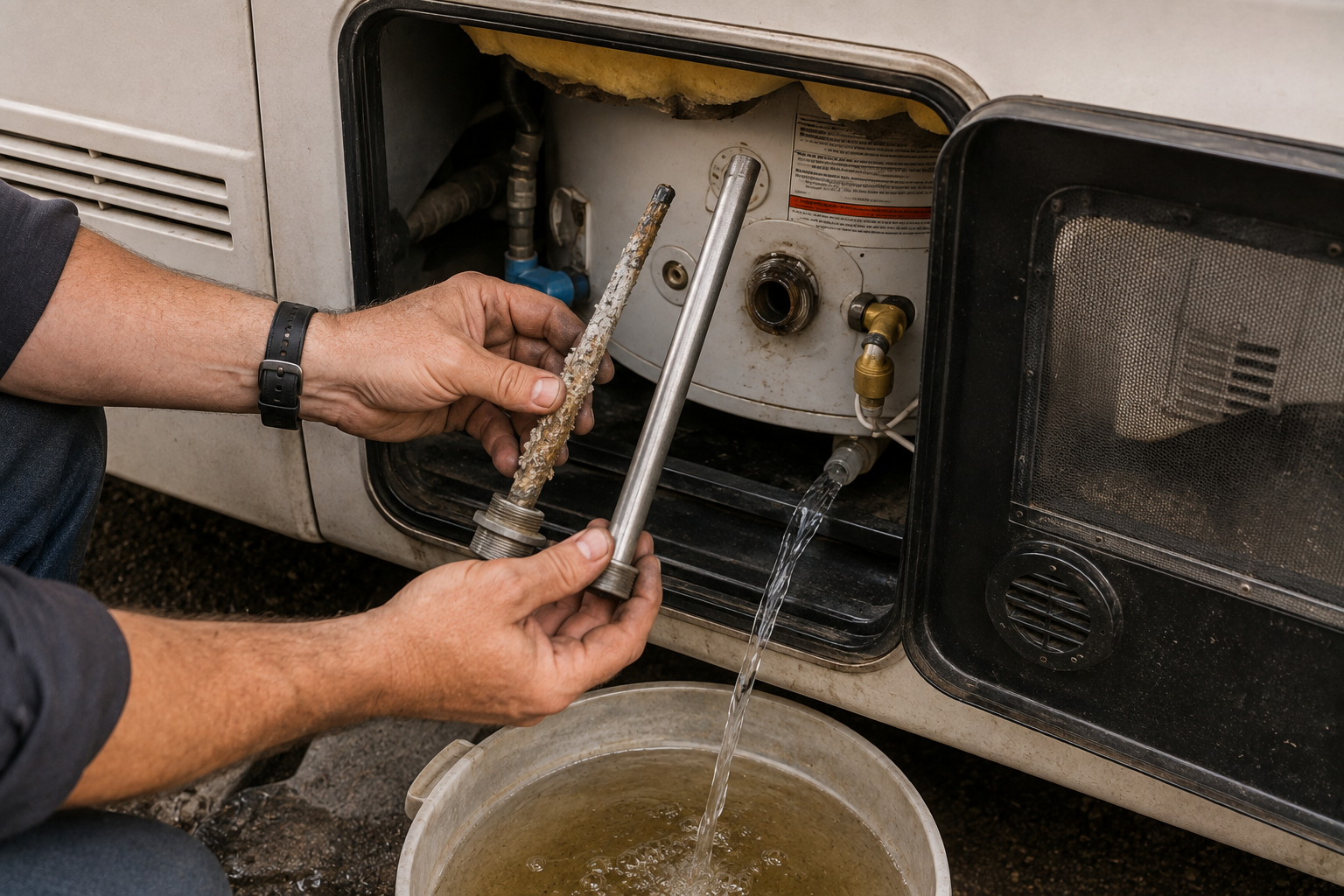
ANODE ROD
Anode Rod Replacement and Tank Flushing
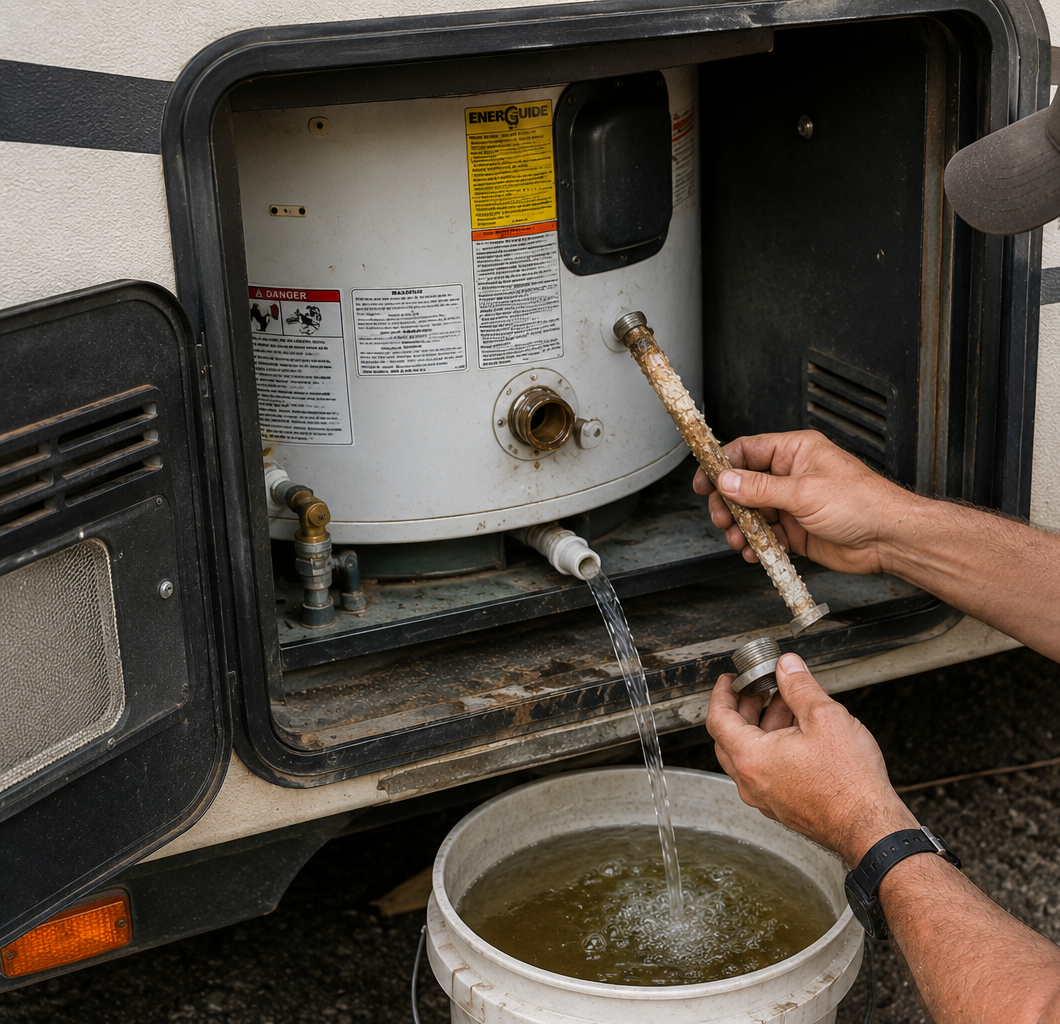
Steel tanks depend on the anode rod corroding in their place, and a rod consumed past about three quarters is no longer protecting anything. We replace it and flush the sediment while the tank is open.
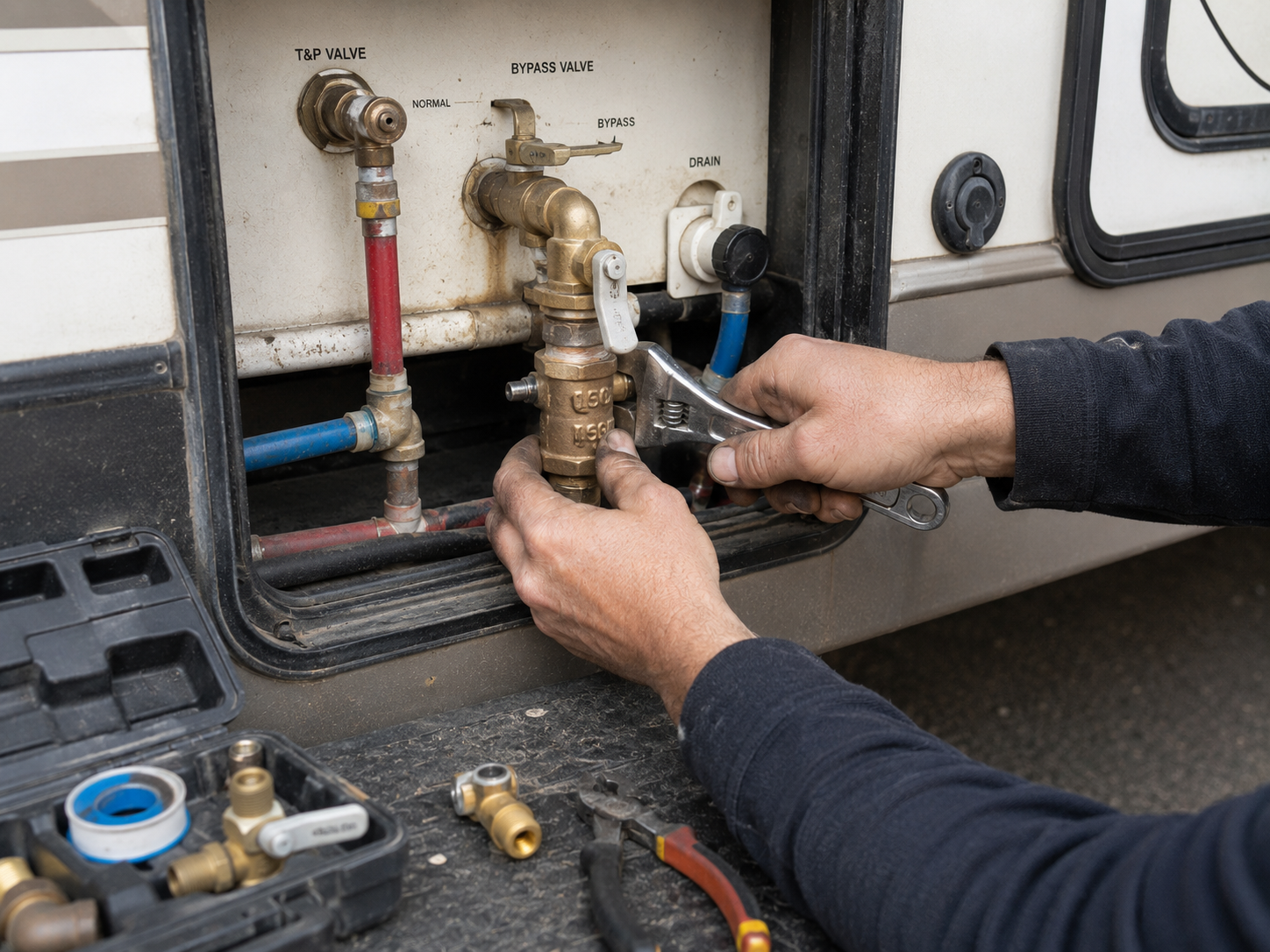
VALVES
Relief Valve and Bypass Valve Service
A weeping pressure relief valve, a bypass left in the wrong position, or a leaking drain plug each produce complaints that look like a failed heater. Correcting the valve work is often the whole repair.
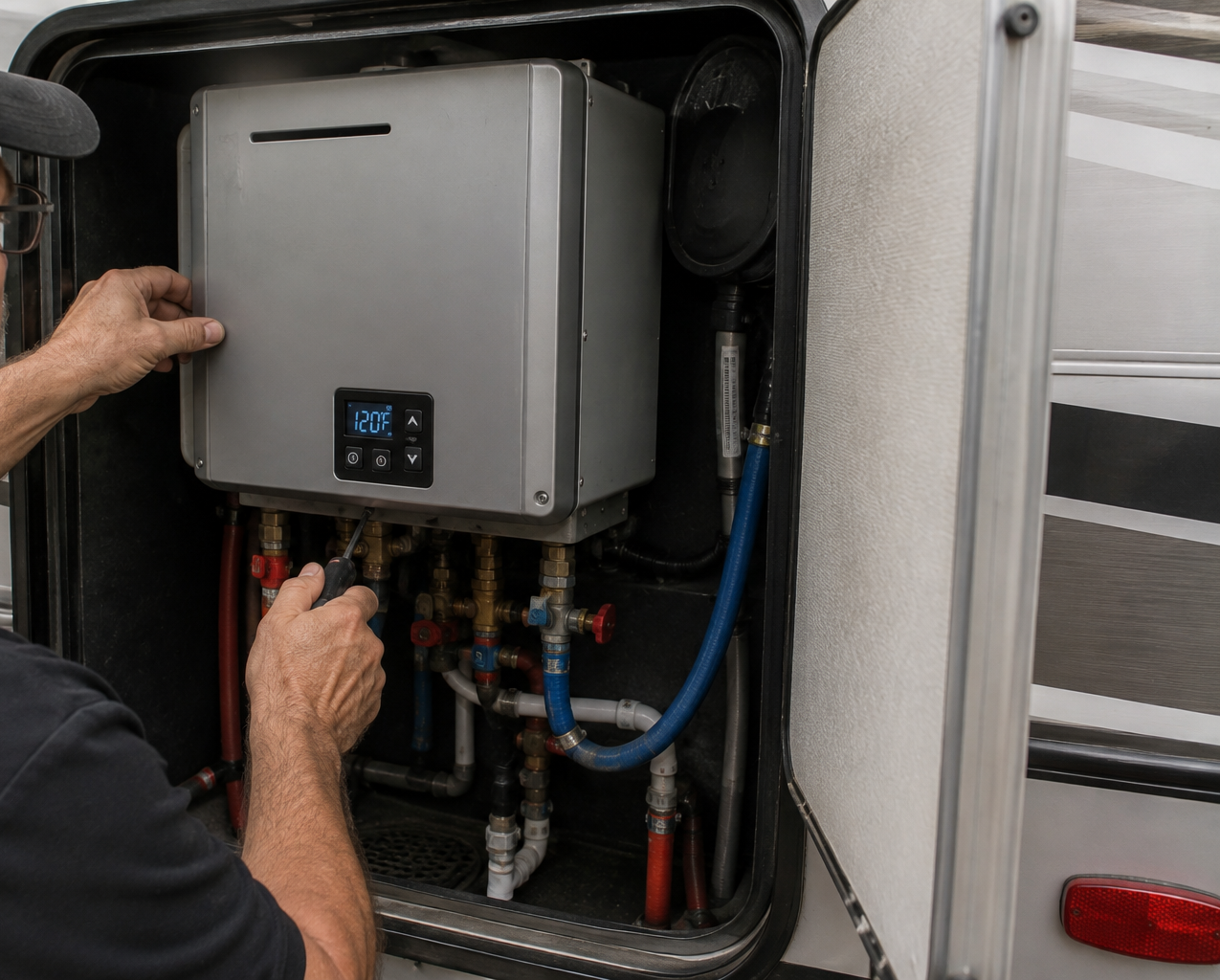
TANKLESS
Tankless Water Heater Service
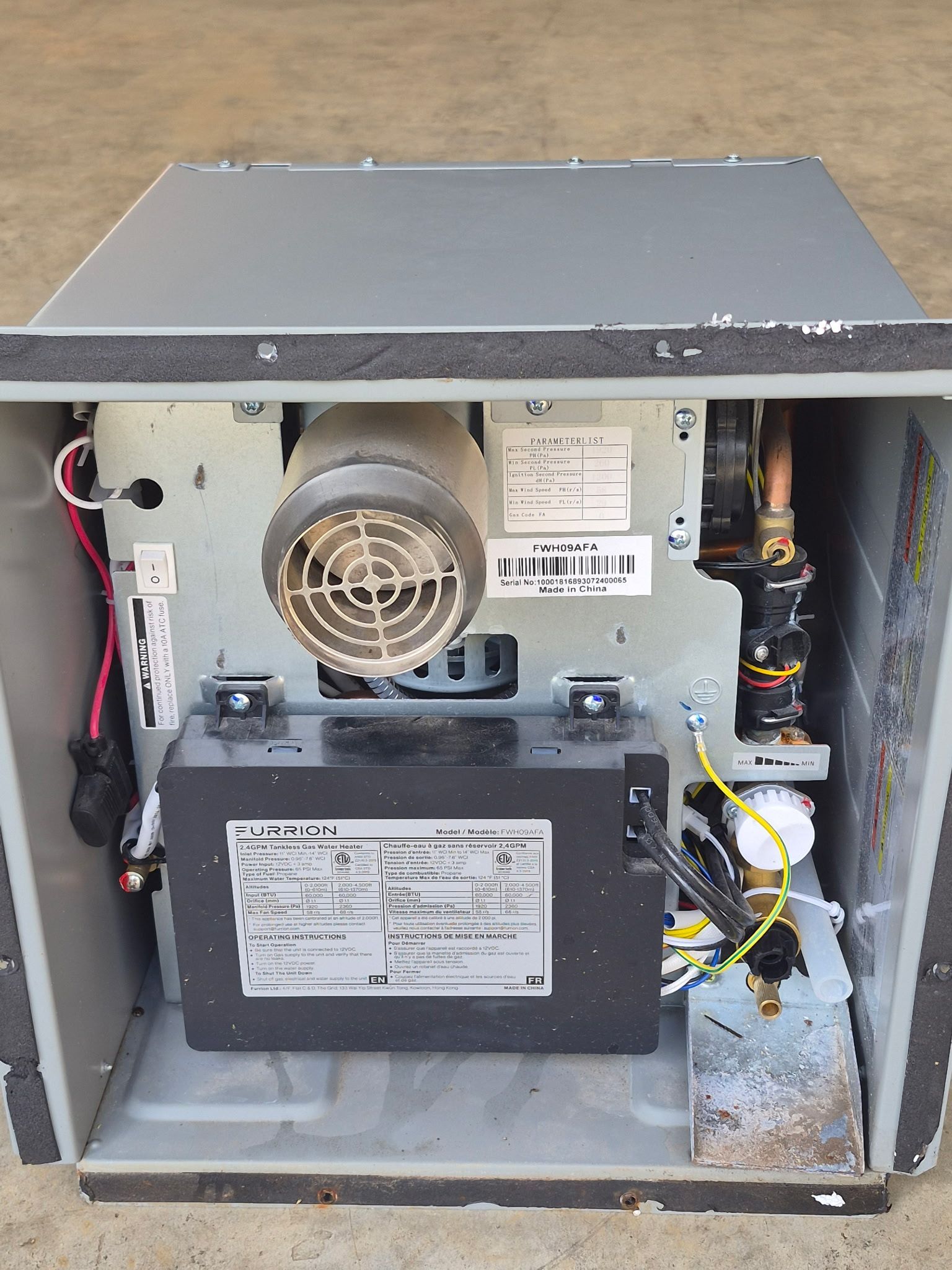
On-demand units modulate their burner with flow and need a minimum flow rate to fire at all, which surprises owners with low pressure. We service, diagnose, and fit these systems where they suit the rig.
REPLACEMENT
Water Heater Replacement
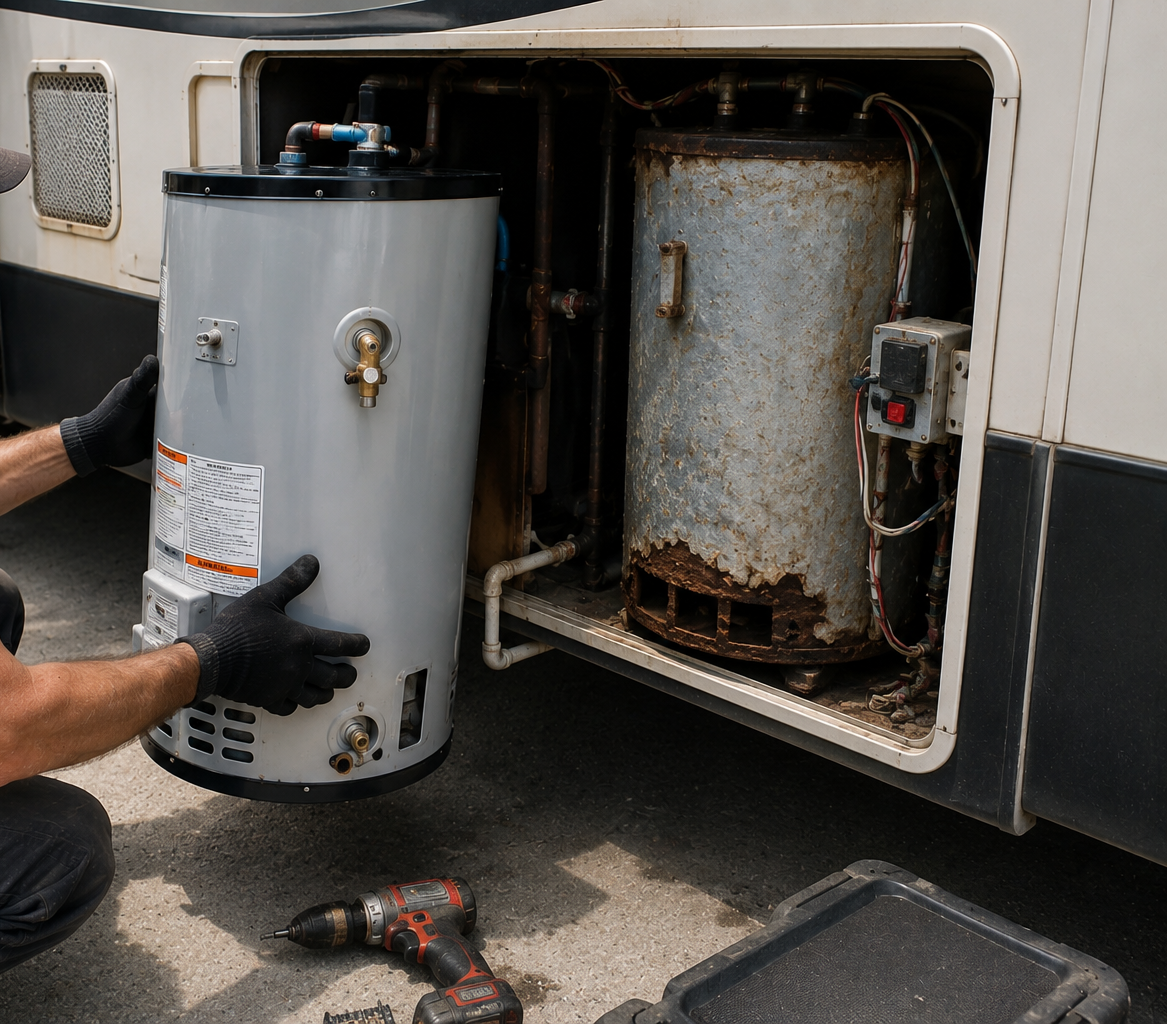
When a tank has corroded through or a unit has aged beyond sensible repair, we fit a replacement sized for the rig. Mounting, gas, water, and electrical connections are all completed and tested.
Common Questions
FREQUENTLY ASKED QUESTIONS.
Water heater questions arrive year round, usually from someone standing in a cold shower holding a flashlight, so here are the ones we field most often.
Why does my RV water heater keep going out?
Repeated flame loss usually points to a weak thermocouple or electrode, a dirty burner tube, wind blowing into the access door, or low propane pressure. Each of those causes the safety circuit to shut the gas valve within seconds.
Why is my hot water only lukewarm?
The most common cause after winterizing is a bypass valve left partly open, which blends cold water into the hot line. A drifting thermostat or a failed element on a dual power unit will do exactly the same thing.
How long does a 6-gallon RV water heater take to heat?
On propane, expect roughly 20 minutes from cold, since gas recovery is far quicker than electric heating. The 1,440-watt element on its own recovers much more slowly, which is why a lot of owners choose to run both of them together.
Why does my water heater work on propane but not electric?
The two heat sources are entirely independent, so the fault lies in the element, its thermostat, the high-limit switch, or the supply circuit. A tripped breaker, a tripped high limit, or a failed element accounts for most cases we see.
How do I reset the high-limit switch on a water heater?
The ECO or high limit sits behind the outside access panel, usually as a small button on the thermostat assembly. Press it to reset, but a switch that keeps tripping needs diagnosis, which Meier RV Repair LLC handles in Coldwater, MI.
Do I need an anode rod in my RV water heater?
Only if your tank is made of steel, which covers the Suburban models. Atwood and Dometic aluminum tanks are designed without one, and installing a rod where the manufacturer never intended one will cause problems of its own.
Why does my RV hot water smell like rotten eggs?
Sulfur odor comes from a reaction between the anode rod, tank sediment, and bacteria in the water rather than from your water supply itself. Flushing the tank and switching over to an aluminum anode rod normally clears it up.
Is a tankless RV water heater better than a tank?
Tankless units deliver continuous hot water with no tank to drain, flush, or protect with an anode rod. They need adequate flow to fire and cost more to install, a trade Meier RV Repair LLC weighs with Coldwater, MI owners.
HOW WE WORK
FROM COLD TAP TO HOT SHOWER, HERE IS HOW.
STEP 01
Confirm what is actually happening
Lukewarm, no hot water, hot then cold, and cold on only one power source are four different faults. We start by pinning down exactly which one you have and when it began.
STEP 02
Check the plumbing path first
Bypass valves, mixing valves, and the anti scald settings account for a surprising share of complaints. Ruling those out costs only minutes and sometimes ends the whole job right there without a single part.
STEP 03
Test gas and electric separately
Each heat source gets run and measured on its own, because a unit can be perfect on one and completely dead on the other. That separation points us straight at the failed component.
STEP 04
Open and inspect the tank
The anode rod comes out for inspection, sediment gets assessed, and the tank interior and its fittings are checked for corrosion. This is where we find out whether service or replacement makes better sense.
STEP 05
Repair with the correct parts
Thermostats, elements, electrodes, gas valves, and anode rods are all matched to your specific model rather than approximated. Using the right rod material for your water supply is part of that decision.
STEP 06
Refill, test, and check for leaks
The system is refilled, purged of air, and run through a full heating cycle while we watch every fitting for weeping. You get hot water tested at the tap before the rig leaves our shop.
GET YOUR REPAIR ESTIMATE
TAKE THE COLD SHOWER OFF YOUR TRIP LIST.
Tell us the make, the model, and what happens on gas and on electric through our contact page. We will explain what testing involves, what parts are commonly needed, and how soon we can schedule the work.
WHAT YOUR SERVICE COVERS:
✓ Both heat sources tested independently
✓ Bypass and mixing valves verified
✓ Anode rod inspected or replaced
✓ Tank flushed of sediment
✓ Relief valve and fittings checked
✓ Full heating cycle run before pickup