RV Refrigerators
RV REFRIGERATORS IN Branch County, MI
Norcold asks owners to keep an absorption refrigerator within 3 degrees of level side to side, because running tilted breaks down the coating protecting the cooling unit tubing. Meier RV Repair LLC repairs RV refrigerators in Coldwater and across Branch County, MI, testing gas and electric operation, burners, boards, thermistors, and sealed cooling units. Diagnosis begins on our contact page.
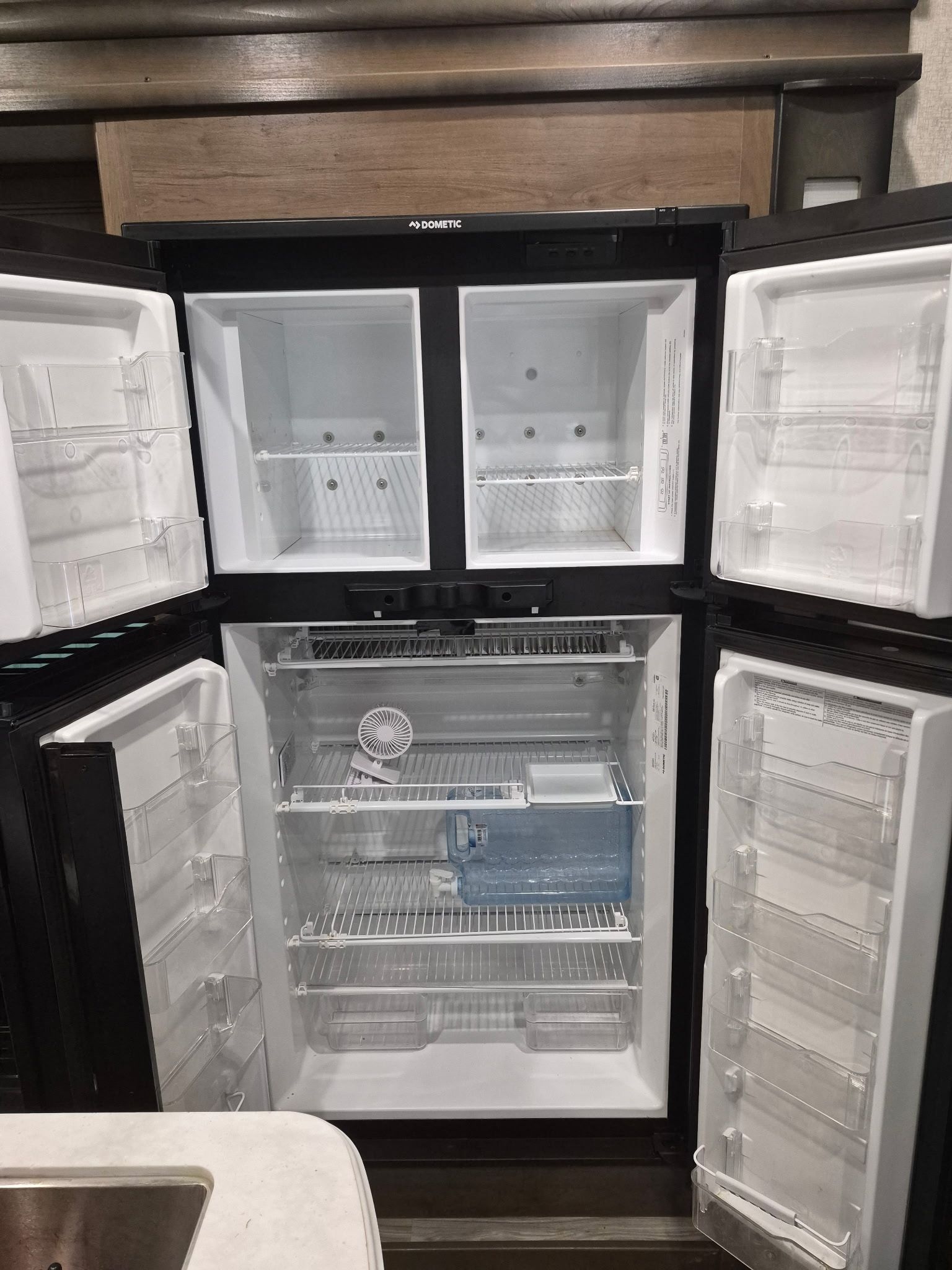
AN ABSORPTION FRIDGE WARNS YOU BEFORE IT QUITS.
The warnings are just quiet ones. A freezer that stays cold while the food compartment drifts warm. A faint ammonia smell when you open the outside vent door. Yellow powder or rust streaks on the back of the unit. Each of those has a specific meaning, and together they usually separate a repairable control fault from a cooling unit that has reached the end.
Knowing which one of those you have before spending money is the entire point of a proper diagnosis, and it is why we test each mode and each component in sequence rather than guessing at the answer.
✓ Gas and electric modes tested separately
✓ Cooling unit inspected for leak evidence
✓ Thermistor, board, and burner checked
✓ Straight answer on repair or replacement
RV REFRIGERATORS
THE COOLING UNIT DECIDES WHAT THIS REPAIR COSTS.
Everything else on an absorption refrigerator can be serviced. The burner assembly cleans, the igniter and thermocouple replace, the board and thermistor swap out, and the flue clears. The sealed cooling unit is the exception, because its ammonia charge cannot be topped up or repaired in place. When that unit has leaked, the choice becomes a remanufactured cooling unit or a new refrigerator. Our testing aims at telling those two apart honestly.
LAKE COUNTRY MEANS UNEVEN SITES AND TILTED FRIDGES.
Around the Coldwater chain of lakes, plenty of favorite sites sit on a slope, and an absorption refrigerator does not tolerate that for long. Beyond about 3 degrees off level, the solution stops circulating properly through the tubing and the protective internal coating starts to break down. Owners rarely connect a lazy fridge to two summers of parking crooked, but that connection shows up constantly in the units we open.
NOBODY SHOULD BUY A FRIDGE THEY DID NOT NEED.
An RV refrigerator is one of the most expensive appliances in the rig, so being wrong about it is costly. A weak thermistor, a dirty burner, a corroded ground, or a failed board all produce symptoms that look exactly like a dying cooling unit. In 10 years of RV work we have found plenty of those, and we would rather find yours than sell you a replacement. What is yours actually doing?
WHAT AN HONEST FRIDGE DIAGNOSIS SAVES
THE COST OF GUESSING
Replacing a refrigerator to solve a thermistor fault is an expensive lesson. Testing each component in sequence puts your money against the part that actually failed rather than the most visible one.
FOOD YOU DO NOT THROW AWAY
A unit that cools inconsistently spoils groceries quietly, usually somewhere far from a store. Reliable cooling protects everything you loaded before leaving and everything you buy along the way.
SAFER OPERATION
Ammonia leaks and burner faults are safety matters, not just cooling complaints. Identifying them early keeps a chemical smell and a scorched flue from becoming something considerably worse inside a closed space.
FASTER COOL-DOWN
A properly serviced unit reaches temperature within the expected window rather than taking a full day and never quite arriving. That makes loading before a trip predictable instead of hopeful.
FEWER ROADSIDE SURPRISES
Most refrigerator failures announce themselves before a trip if somebody looks. Catching them in the driveway is considerably better than discovering warm food 200 miles from home.
A CLEAR REPAIR DECISION
Knowing whether you are looking at a part, a cooling unit, or a whole appliance lets you plan. Ambiguity is what makes this repair stressful, and testing removes most of it.
WHAT WE DIAGNOSE
OUR RV REFRIGERATOR WORK
Refrigerator faults divide neatly between things that can be repaired and things that cannot, and testing sorts them quickly. This is the refrigerator work we take on at our shop.
COOLING FAULTS
No Cooling Diagnosis
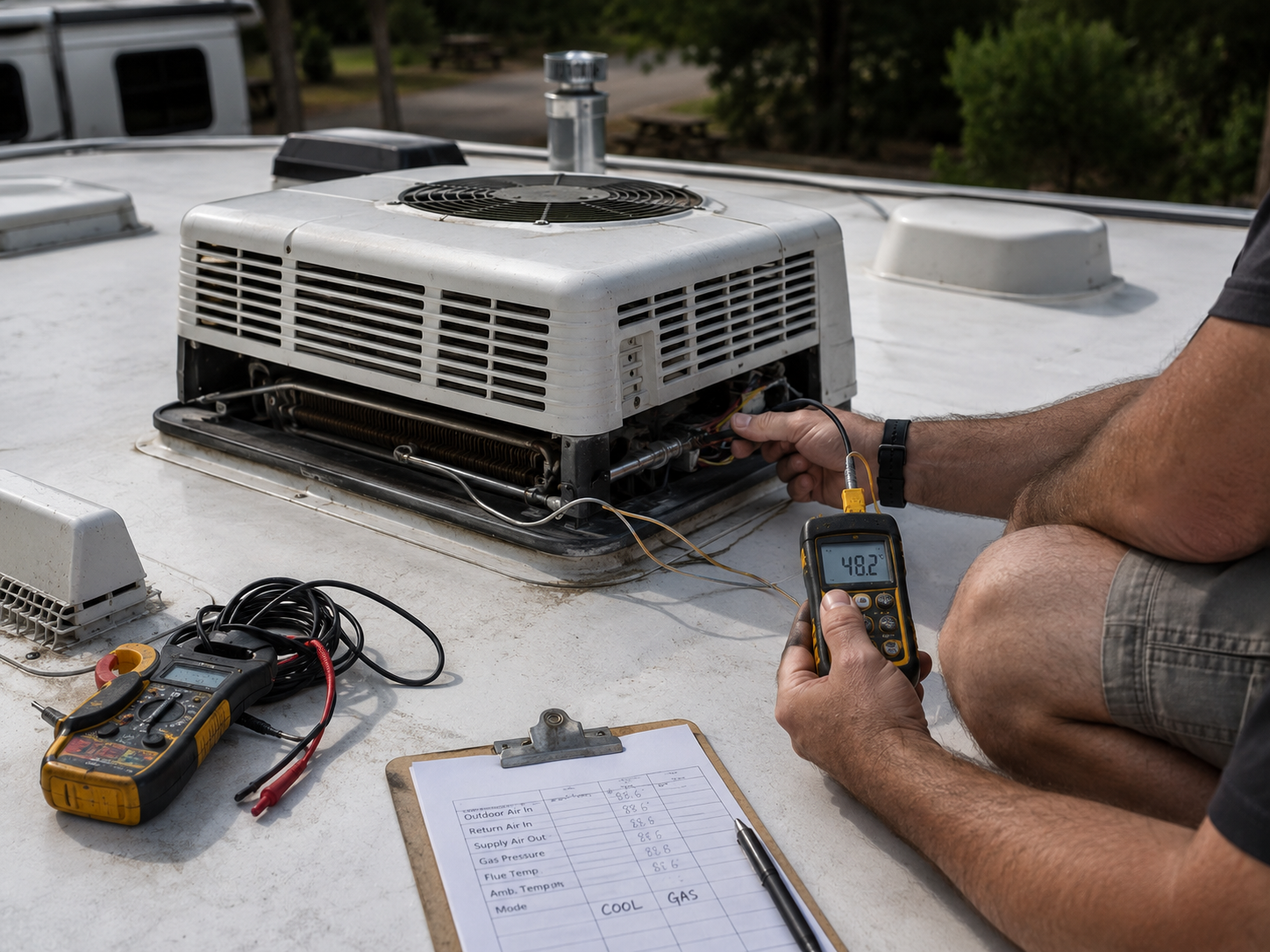
We run the unit in both gas and electric modes, take temperature readings over time, and check the flue, burner, and cooling unit. Those results narrow the fault long before anything is disassembled.
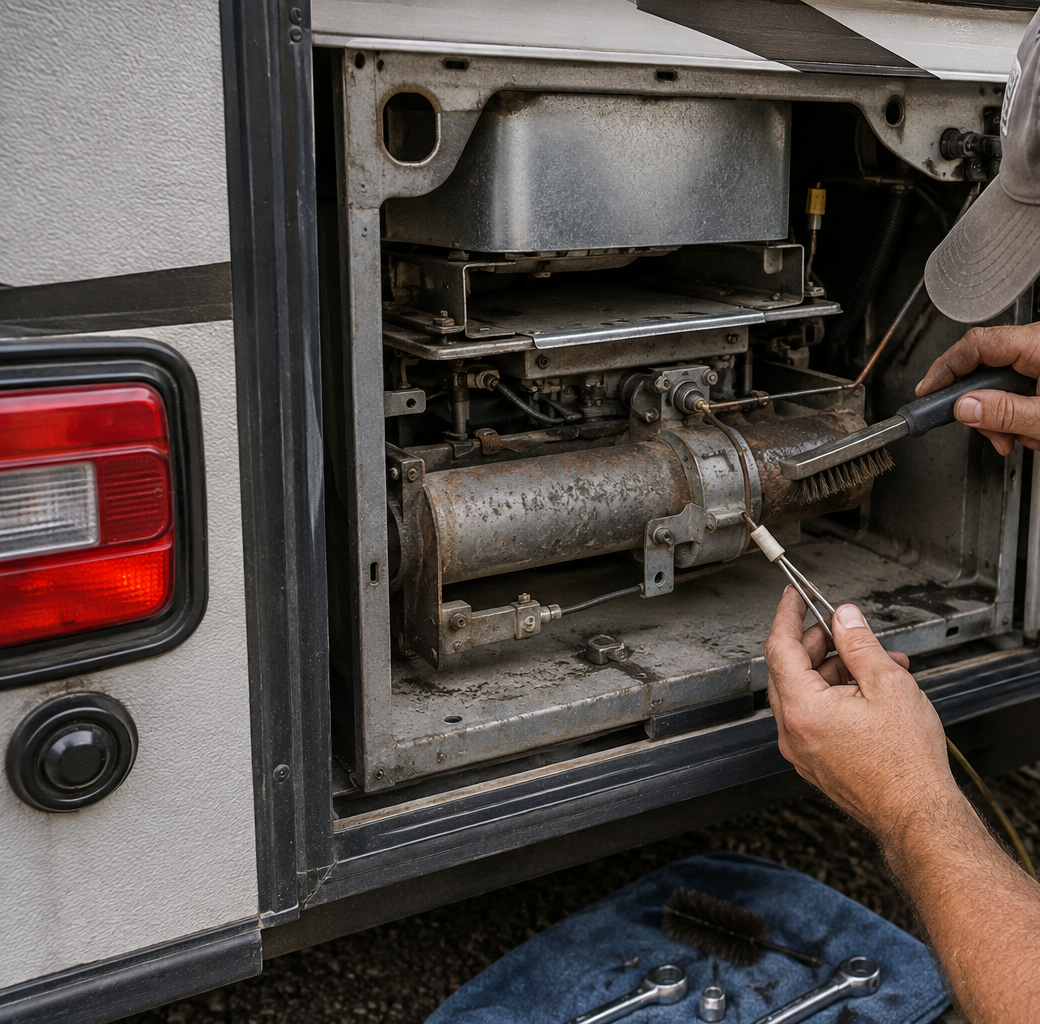
GAS SIDE
Burner, Igniter, and Flue Service
Soot, spiders, and rust flakes choke the burner and flue on units that live outdoors. Cleaning the assembly, adjusting the flame, and replacing worn igniters or thermocouples restores gas operation on most older refrigerators.
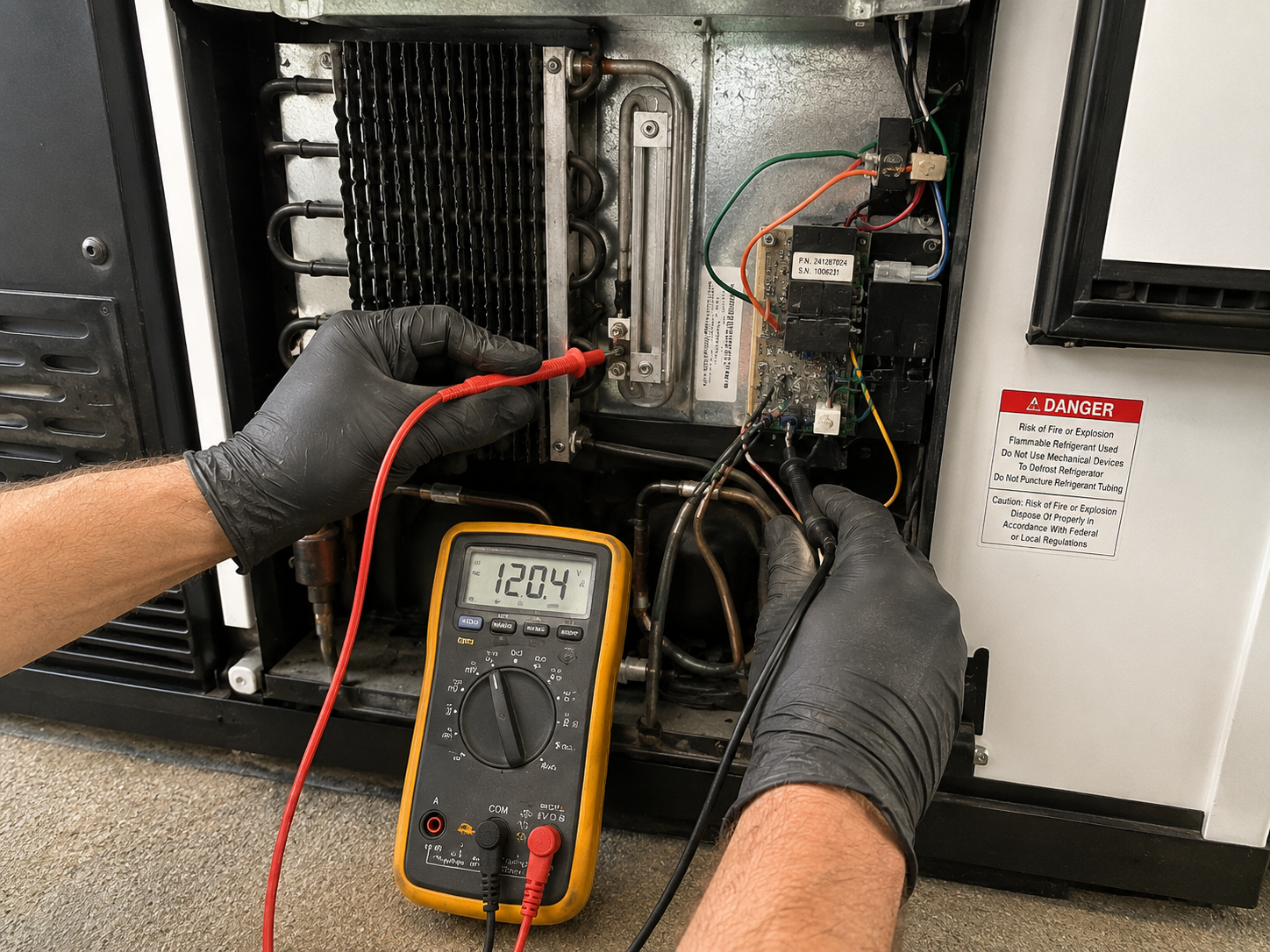
ELECTRIC SIDE
Heating Element and Power Testing
When a fridge cools on propane but not on shore power, the electric element, its wiring, or the board relay is usually at fault. We test resistance and supply voltage rather than replacing components speculatively.
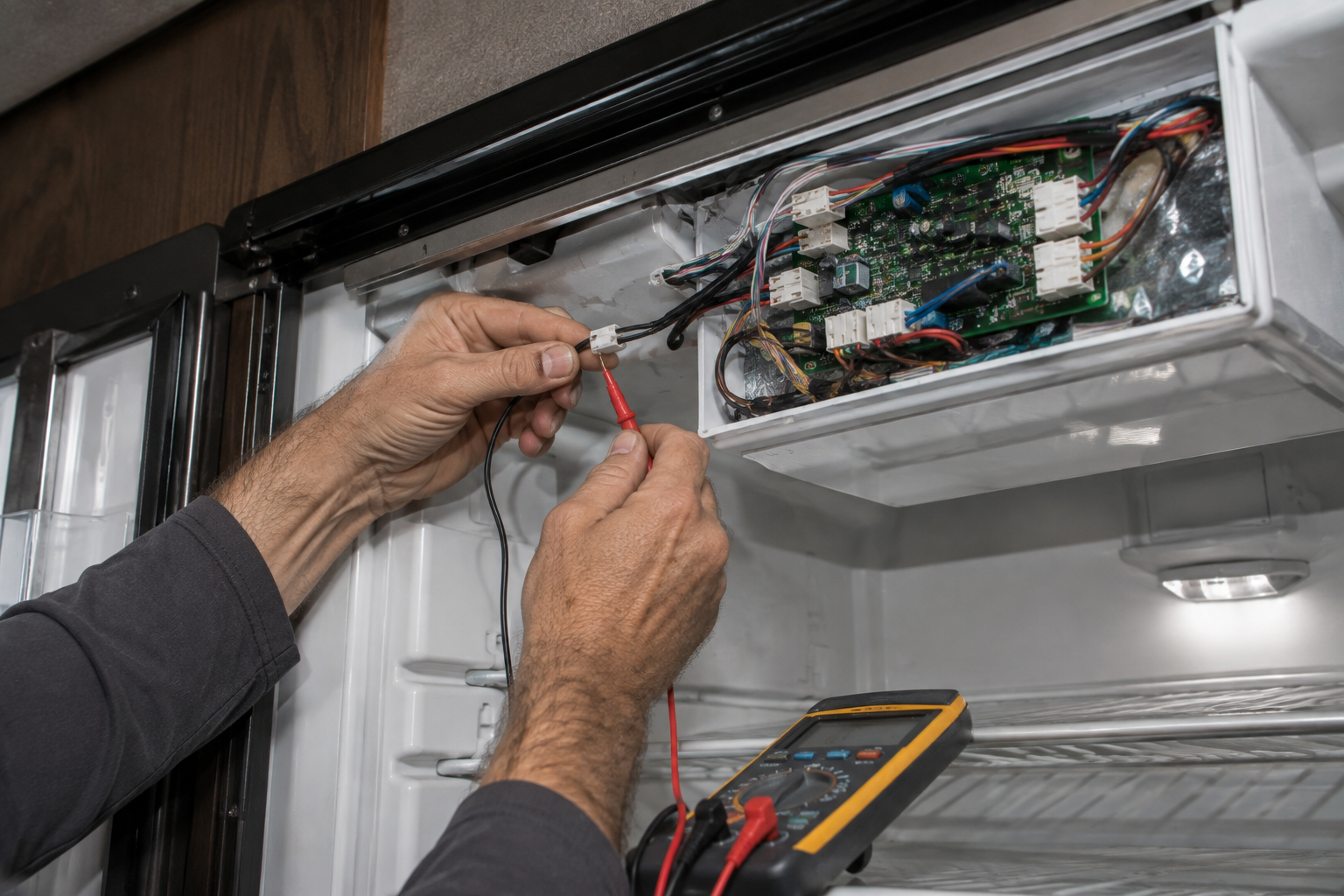
CONTROLS
Thermistor and Control Board Repair
A drifted thermistor reports the wrong box temperature, which produces freeze ups in one compartment and warm food in the other. Testing it and the board together settles whether the cooling side is even involved.
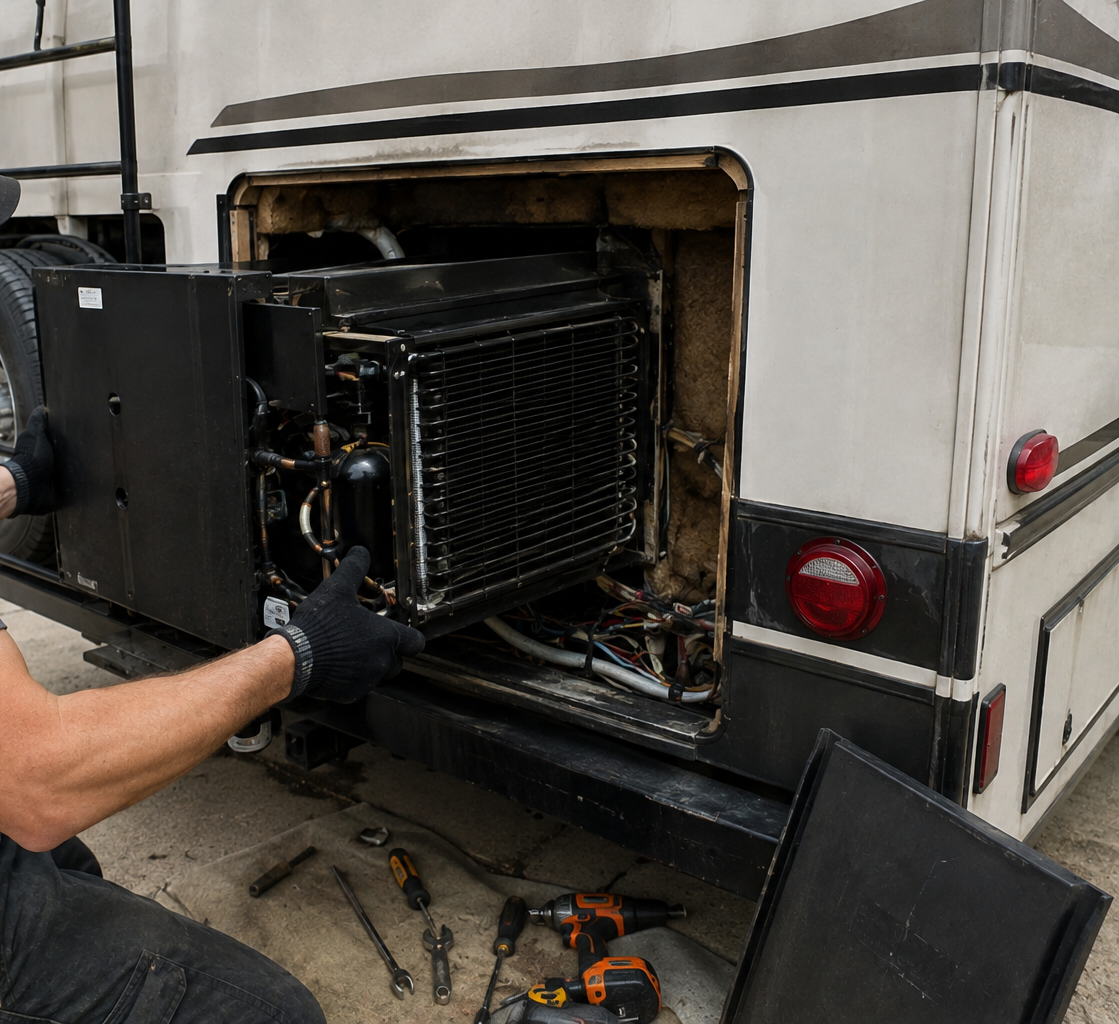
COOLING UNIT
Cooling Unit Replacement
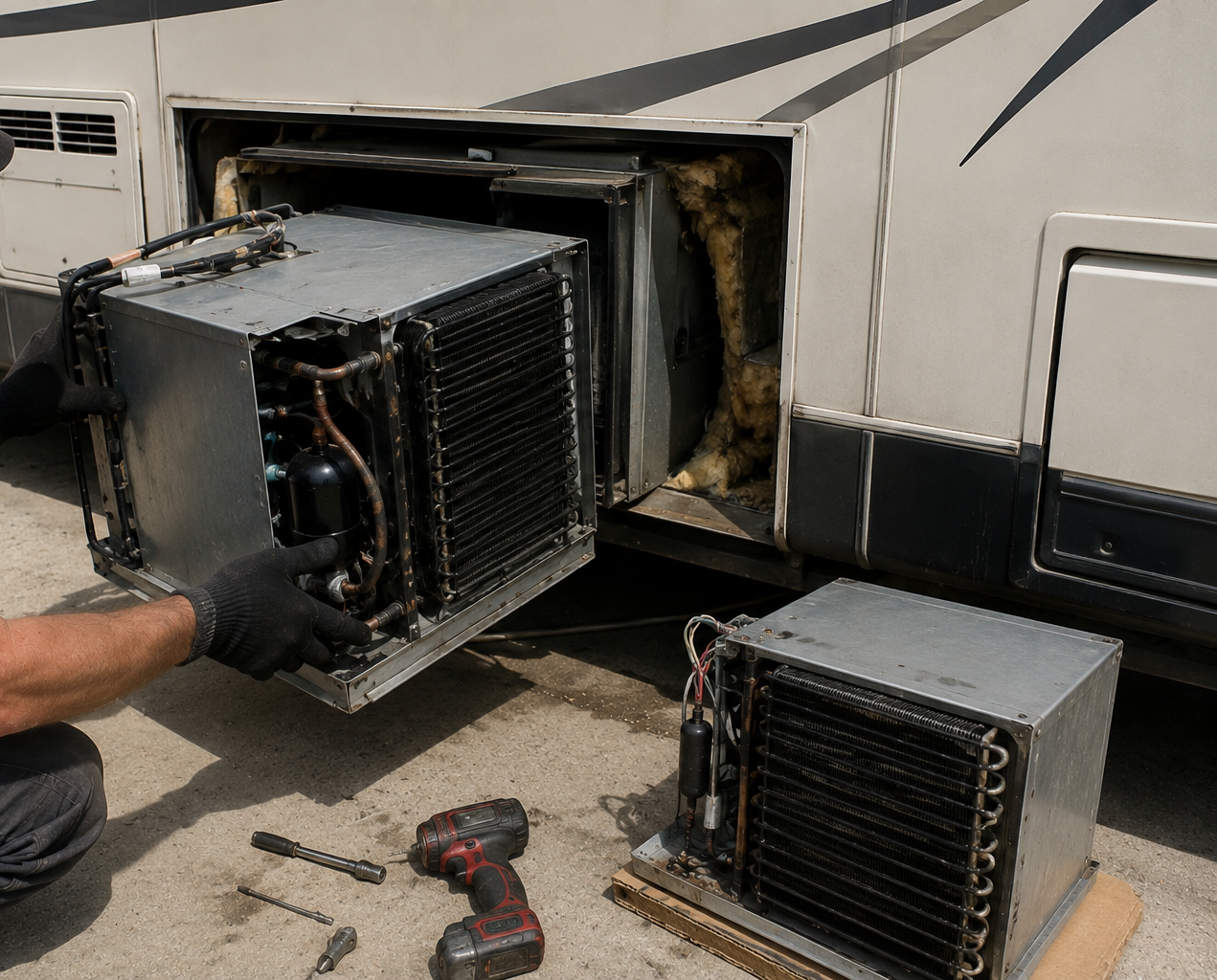
Yellow residue, rust streaks, and a sharp ammonia smell mean the sealed unit has leaked and cannot be repaired in place. We fit a remanufactured or new cooling unit and reinstall the refrigerator properly.
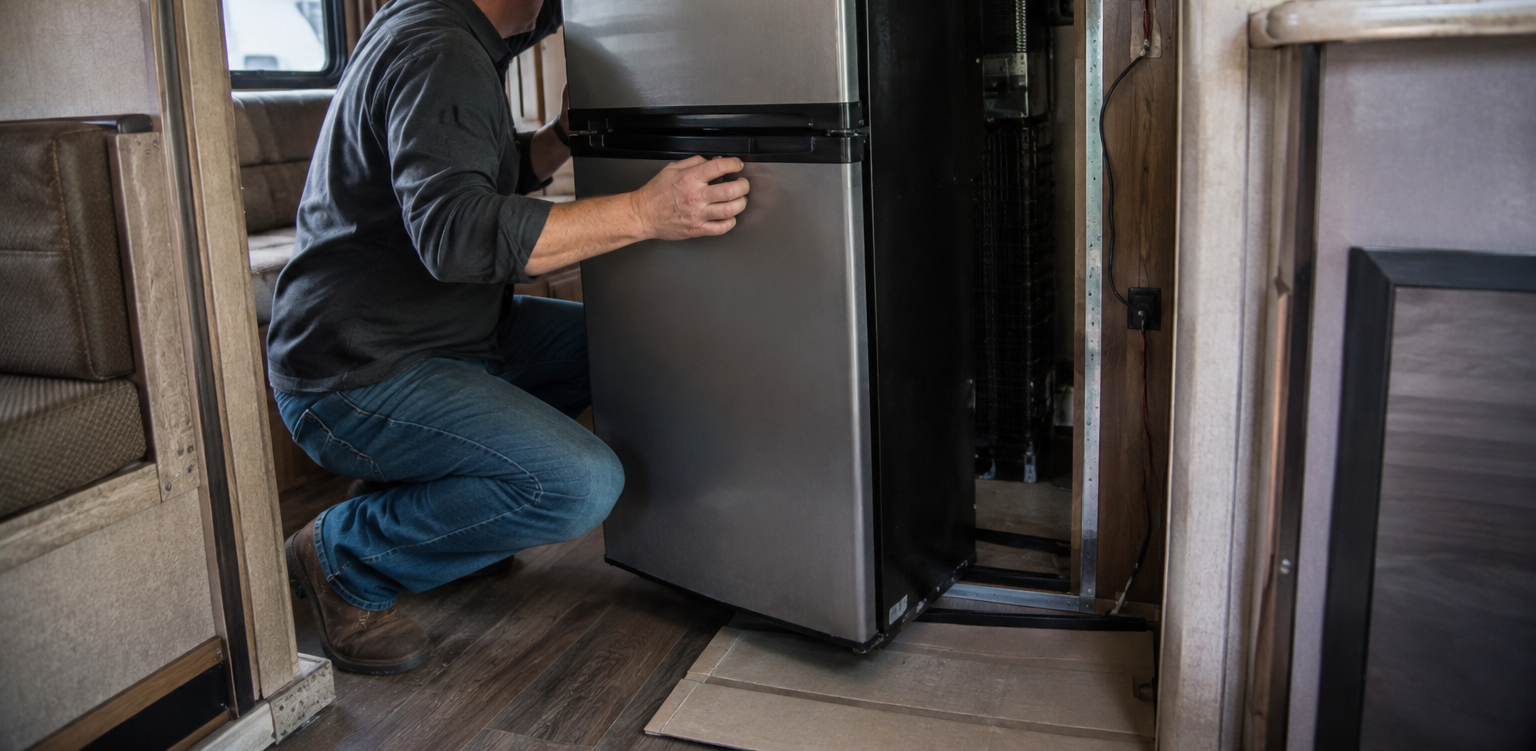
REPLACEMENT
Refrigerator Removal and Replacement
Sometimes a new appliance is the sensible answer, including a 12-volt compressor model that does not care about level. We handle removal, fitting, venting, and the electrical work that comes with it.
Common Questions
FREQUENTLY ASKED QUESTIONS.
Absorption refrigerators behave unlike anything you have in a house, so these questions come up in almost every conversation that we have with owners about them.
Why does my RV refrigerator work on electric but not propane?
That points at the gas side rather than the cooling unit itself. A blocked or sooted burner, a weak igniter, a failed thermocouple, or low propane pressure will all stop gas operation while electric heating continues working normally.
How level does an RV refrigerator need to be?
Manufacturers generally want an absorption unit within roughly 3 degrees side to side and 6 degrees front to back while running. Parked outside that range, the solution stops circulating and damage accumulates, which Meier RV Repair LLC sees constantly in Coldwater, MI.
How long do RV refrigerators last?
Absorption units commonly run 10 to 20 years, with the cooling unit itself often reaching about 15. Level operation, clean flues, and stable voltage all extend that, while years of parking on a slope will shorten it considerably.
What does yellow powder behind the refrigerator mean?
That yellow residue is a signature of an ammonia leak from the sealed cooling unit, often paired with rust streaks and a sharp odor. Once that residue appears, the cooling unit needs replacing rather than repairing, since it cannot be recharged.
Why is my freezer cold but the fridge warm?
That pattern usually points to a thermistor reading incorrectly, a blocked internal air path, or a failing baffle rather than a dead cooling unit. It is one of the more commonly misdiagnosed refrigerator complaints that we see in the shop.
Is it worth replacing just the cooling unit?
Frequently, yes. A remanufactured cooling unit costs meaningfully less than a complete refrigerator and suits a rig whose cabinetry is built around the existing box. Meier RV Repair LLC has weighed that choice in Coldwater, MI for 10 years.
How long does an RV refrigerator take to get cold?
Plan on 8 to 24 hours before an absorption unit is genuinely at temperature, which is why they should be started the day before loading. Adding warm food to the box early on only extends that whole process further.
Can I run my RV refrigerator on propane while driving?
Many owners do, while many others switch over to electric or 12-volt operation for travel days instead. The open flame near fuel stations is the concern people usually raise, and some jurisdictions and tunnels do prohibit it outright.
HOW WE WORK
FROM SYMPTOM TO STRAIGHT ANSWER, HERE IS HOW.
STEP 01
Gather the history
We ask how long the fault has run, whether it happens on gas, electric, or both, and how the rig is usually parked. Level history matters more with these units than with anything else.
STEP 02
Test both operating modes
The refrigerator runs on propane and then on shore power while we log temperatures over time. Comparing the two modes tells us immediately whether the fault sits on the heat source side or deeper.
STEP 03
Inspect the back of the unit
The outside vent panel comes off for a proper look at the burner, flue, boiler, and cooling unit. Yellow residue, rust showers, or a sharp ammonia odor answer the question right there.
STEP 04
Check the controls and power
Thermistor readings, board function, connections, and supply voltage all get verified before anything at all is condemned. Corroded grounds and weak connections cause far more refrigerator complaints than most owners would ever expect.
STEP 05
Give you the options and costs
You hear what we found, what repair would involve, what a cooling unit would involve, and when replacement is the better value. The decision stays yours, made with the actual findings in hand.
STEP 06
Repair, reinstall, and verify
Whatever the path, the unit is refitted with proper venting and sealing, then run through a full cool-down cycle before pickup. We confirm that it holds temperature rather than assuming that it will.
GET YOUR REPAIR ESTIMATE
FIND OUT WHAT YOUR REFRIGERATOR ACTUALLY NEEDS.
Tell us the make, model, and what the unit is doing on each power source through our contact page. We will explain what testing involves and how quickly we can get you an answer worth acting on.
WHAT YOUR DIAGNOSIS COVERS:
✓ Cooling tested on gas and electric
✓ Burner, flue, and igniter inspected
✓ Cooling unit checked for leak evidence
✓ Thermistor and control board tested
✓ Supply voltage and grounds verified
✓ Repair, cooling unit, or replacement explained