Soft Spots on Your RV Roof? What Is Happening Underneath
August 31, 2026
QUICK ANSWER: A soft spot on an RV roof is water damage that has already worked its way beneath the membrane. The rubber or thermoplastic skin on top is barely thicker than a dime, and the plywood decking under it is thin sheeting that loses its strength once it stays wet. A spongy area means moisture reached that wood, started rotting it, and is likely spreading sideways into the walls and slideout floor. It rarely fixes itself. Stopping it means finding the entry point, cutting out the ruined decking, and rebuilding the layer underneath.
You climb up to clear leaves off the roof, take a step near the front cap, and the surface gives under your foot like a wet cardboard box. It does not crack, and from a distance the membrane still looks fine. That soft, sinking feeling is the roof telling you something the outside cannot: water has already gotten past the skin, and the wood that gives the roof its strength is coming apart. By the time you can feel it through your boot, the problem is no longer on the surface.
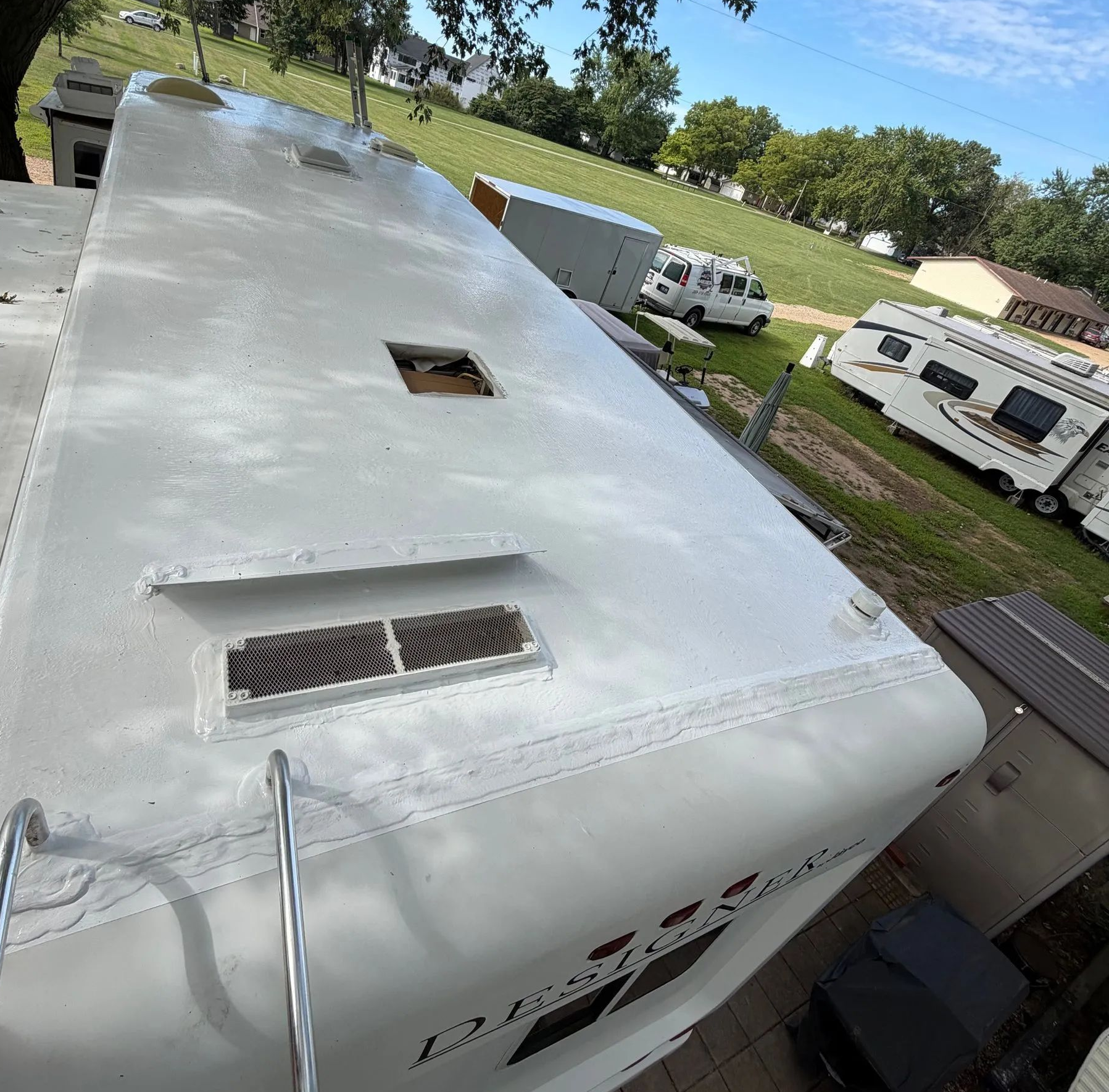
An RV roof is built in layers. On top sits a thin membrane, either rubber or a thermoplastic sheet, stretched over plywood decking that is kept deliberately thin to save weight. Under the plywood run the rafters and a layer of insulation, then the interior ceiling panel. That whole sandwich stays sound only as long as the membrane and its sealant keep water out. Once water finds a way in, it goes after the one part that cannot handle it: the wood.
Why the Roof Goes Soft in the First Place
Water almost never comes straight through the middle of a healthy membrane. It enters at the interruptions, the places where something pokes through the roof or two pieces meet. Vents, the air conditioner, fans, skylights, antennas, and the front and rear caps are all sealed with lap sealant and gaskets, and those are the first things to fail.
Sealant does not last forever. It chalks, shrinks, and pulls away from the flanges it was meant to bond to, opening a gap you would need to be on the roof to see. A screw head backs out a fraction as the rig flexes down the highway. A gasket under the air conditioner flattens and stops sealing. Any one of those lets water trickle onto the decking below, slowly, a little with every rain. The membrane itself can also thin, tear, or get punctured by a branch, but the seams and penetrations cause most of what turns into a soft roof.
What the Sponginess Actually Tells You
A soft spot is not just a weak patch of roof. It is a status report on damage that started a while ago. When you feel that give underfoot, several things are usually true at once. Water has been present long enough to break down the plywood. The decking in that area is rotting and no longer carrying load. The insulation beneath it may be saturated and holding moisture against the wood. And the damage is probably larger than the soft area you can feel.
That last point is the one that catches owners off guard. Water travels sideways through plywood, wicking along the wood well past the original leak. So the rot spreads out from the entry point in every direction, often reaching the walls and settling down into the slideout floor before a single stain shows up on the ceiling inside. You can have a structurally compromised roof and a clean-looking interior at the same time. The stain, when it finally appears, is late news.
TIP: Walk your roof gently a couple of times a season and press along every seam, around each vent, and beside the air conditioner. Catching a spot while it is barely spongy, before the ceiling sags inside, is the difference between replacing two sheets of plywood and rebuilding the whole top of the rig.
How Michigan Weather Speeds It Up
A soft roof develops faster in this climate than almost anywhere else, and the reason is the freeze and thaw cycle. Great Lakes winters run a rig through dozens of freeze-thaw swings across a single season, and each one works on the sealant. Water that has seeped into a tiny crack expands as it freezes, widening the gap, then melts and seeps deeper. Repeat that 40-some times a year and a hairline crack becomes an open path.
Snow load does the rest. Coldwater collects roughly 27 inches of snow across a winter, and on a flat
RV roof it sits there for months instead of sliding off. That standing weight presses on decking that is already damp, and wet plywood flexes and delaminates under a load that dry wood would shrug off. This is why so many owners discover the damage in April: the rig comes out of storage, the ceiling panel is sagging, and the trim no longer meets the wall. Sealant formulated for a mild, dry winter can split open here in two or three seasons, which is why the material and the temperature it goes on at both matter so much in this part of the country.
Why More Sealant Makes It Worse
The instinct when a roof starts leaking is to add sealant, roll on a coating, or slap a patch over the soft area. On a sound roof, fresh sealant at the right spot is exactly right. On a roof that is already wet underneath, it is the wrong move.
Sealing over trapped moisture does not dry the wood out. It seals the water in, keeps it pressed against the plywood, and lets the rot keep working in the dark where you cannot see it. A coating applied over a soft area looks like a fix for a season, then the spongy patch comes back larger because nothing underneath ever dried or got replaced. The same goes for a patch laid over rotted decking: the patch holds, the wood beneath keeps failing. Any real repair has to start by getting the moisture and the ruined wood out, not by capping them.
WARNING: Do not let anyone put a fresh coating or a patch over a spot that already feels soft. It hides the damage instead of stopping it, and the next person to find out how far the rot spread will be whoever opens that roof up later, with a much bigger repair on their hands.
Picking a mount that can handle the spot
What a Real Repair Involves
Fixing a soft roof means working from the outside in and being honest about what the wood is doing. The first step is finding every entry point, because patching the decking without stopping the leak just repeats the whole job in a year. That means a real inspection: tapping and probing the surface to map how far the soft area extends, checking each seal, and, where it helps, water testing or running pressurized air with a soapy solution around the penetrations to make hidden openings bubble up.
Once the extent is known, the ruined section gets opened up. Rooftop components come off, the membrane is peeled back, and the soft plywood is cut out all the way to sound wood, since compromised sheeting will not hold a fastener or safely carry the weight of an air conditioner. New decking goes in fastened to the rafters, not patched over from above, and the surface is brought back level. Then a new section of membrane, or a whole new membrane if the old one is failing across the roof, gets bonded down flat, and every vent, fan, and skylight goes back with fresh gaskets and sealant rather than the flattened ones that leaked before.
Whether the answer is a targeted repair or a full replacement comes down to two things: how much decking is soft and how much life is left in the membrane. Local damage under a membrane that is otherwise sound is a repair. A substrate that is soft across a wide area, a membrane near the end of its rated life, or seams you have already resealed several times point toward replacement. A rubber membrane is generally rated around 10 to 15 years and a thermoplastic one longer, so the age of the roof is part of the math too. The point of the inspection is to match the work to what the roof actually needs instead of guessing from the ground.
Frequently Asked Questions
Is it safe to walk on a soft RV roof?
Be careful. A soft area means the plywood has lost strength and may not hold your weight. Stay over the rafters where you can, spread your weight out, and step off anything that clearly gives underfoot.
Can a soft spot on an RV roof be repaired, or does the whole roof need replacing?
It depends on the spread and the membrane's condition. An isolated soft area under a sound membrane can be opened up, the bad decking cut out and replaced. Widespread softness or an aging membrane points to replacement.
Why does my ceiling look fine if the roof is soft?
Because water moves sideways through plywood before it drips down. The decking can rot outward from the leak while the ceiling panel still looks dry. Interior stains are usually the last sign, not the first.
How fast do soft spots spread in a cold climate?
Faster than in a mild one. Freeze and thaw cycles widen the cracks that let water in, and months of snow load press on damp decking until it delaminates. Many owners find the damage after storage.
Will a roof coating fix a soft spot?
No. Coatings protect a sound roof, they do not repair a wet one. Rolling one over a soft area seals moisture in and lets the rot continue while the surface looks fine for a season.
How often should I check my RV roof to catch this early?
Press the seams and penetrations a few times during the camping season, then again before and after winter storage. Most manufacturers also call for a seam inspection every few months, which catches failing sealant early.
What a Soft Roof Is Really Telling You
A soft roof is really a timeline. The give underfoot marks where water sat long enough to break the plywood down, and the quiet spread outward from there has been going on far longer than the sponginess suggests. Sealant and coatings only address the surface; the wood is what carries the load, and once it turns, nothing rolled on from above brings it back. What matters most is how early the spot gets found, and how honestly it gets opened.
Roofs that get walked, pressed, and resealed on a regular schedule rarely reach that point, which is why seasonal checks are worth more than any single repair. When one does go soft, Meier RV Repair LLC
has spent 10
years opening these roofs up across Branch County, MI, tracing leaks back to their actual source rather than the stain they leave behind. The honest answer usually shows itself the moment the membrane comes back and the decking is finally visible.